Manufacturing Case · Branded Merchandise · B2B Trade-Show Activation
Branded Acrylic Giveaway: 1,500-Unit B2B Trade-Show Rollout in 14 Days
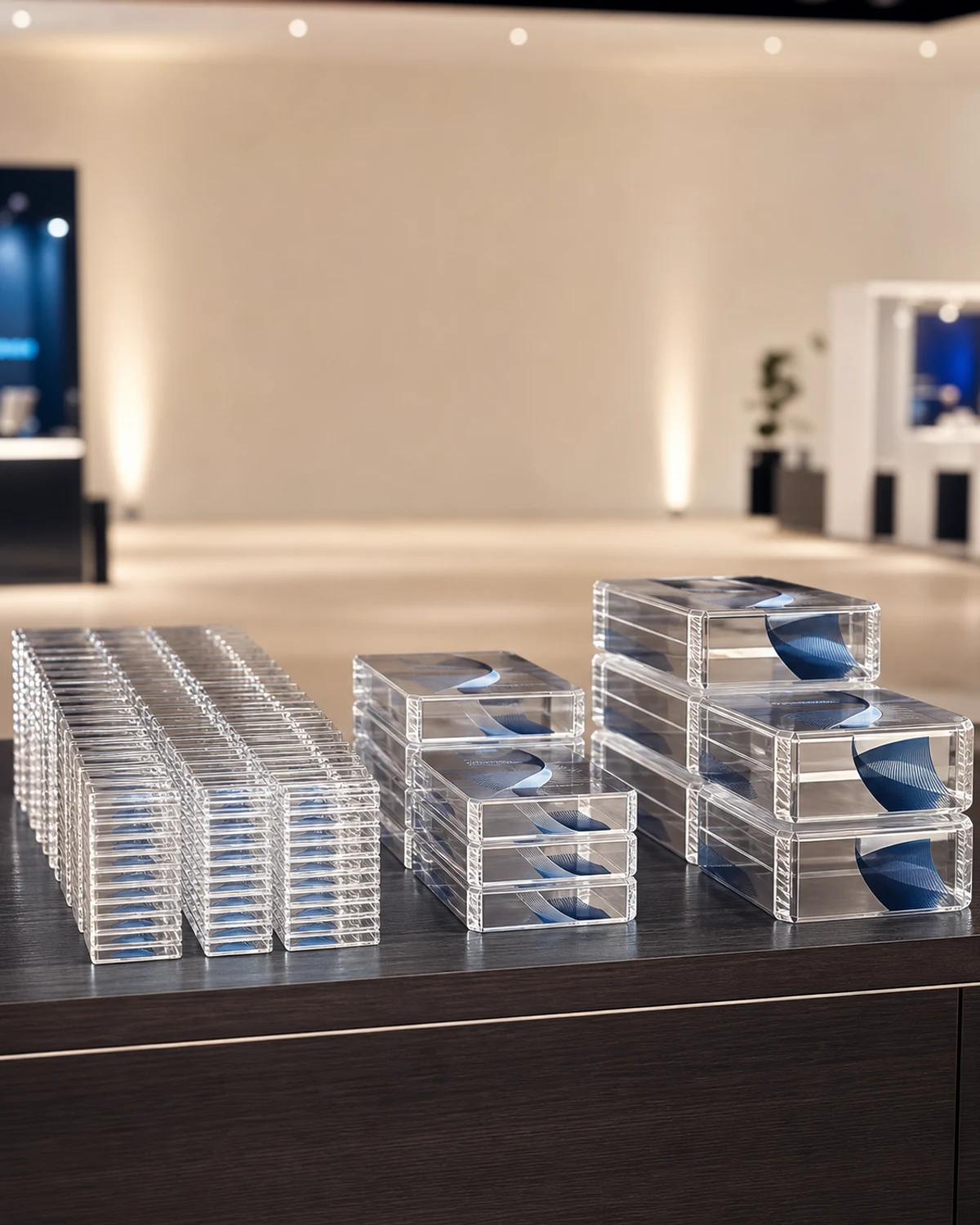
This 1,500-unit trade-show plan creates three clear value tiers without fragmenting the visual identity: 8 mm booth-walker pieces, 15 mm qualified-lead pieces, and 25 mm VIP pieces. Wetop combines front-face UV print, an engraved edge signature, and event-ready foam-grid packing; the sample approval and event date determine the production and freight path.
- Program input · program units
- 1,500
- Program input · engagement levels
- 3 tiers
- Program input · production target
- 15–20 days
- Program input · packing input per case
- 300
Key Takeaways
- 3-tier giveaway program (booth-walker / qualified-lead / VIP-meeting at 8 / 15 / 25 mm thickness) hit perceived-premium scaling without 3× the unit cost — shared tooling across tiers cut tooling overhead 50%.
- UV-print on the front face + laser-engraved edge on the long side combined visual brand identity (printed graphic) with tactile signature (engraved edge) — recipients flag the edge engraving as the surprise detail.
- Foam-grid insert at 300 units per case let booth staff carry the giveaway inventory in roller-luggage cases through airports without TSA flagging or freight-handling damage in transit.
- 14-day rush production hit the trade-show booth opening date with 4 days margin, supported by a single-mill substrate batch covering all 3 tiers and shared CNC fixturing across the SKU thicknesses.
The Brief
The buyer ran brand activations for a growth-stage B2B SaaS brand. Trade shows were the primary lead-generation channel for the upcoming quarter, with a major US events circuit show 18 days from when she contacted us. The previous year's giveaway program had been generic stress balls — recipients tossed them in the airport trash. She wanted something that recipients would keep on their desk for years and that signaled the brand's positioning.
Constraints: 1,500 units across 3 perceived-premium tiers (high-volume booth walker, qualified-lead, VIP meeting), all-in production budget capped at $18,000 (= $12 per unit average), trade-show booth open in 18 days (so 14-day production window with 4-day shipping margin), and the giveaway needed to be portable enough that booth staff could carry the inventory through airport TSA in roller luggage.
Our Recommendation
Three production decisions that turned a $12-average budget into a 3-tier program with credible perceived-premium across tiers.
Shared tooling across 3 thicknesses
Standard quote pattern: 3 separate CNC and polishing setups for 3 thicknesses, with three full tooling investments. The shared approach: same outline geometry and same UV-print position across all 3 tiers, only thickness varies (8 / 15 / 25 mm). The single CNC fixture handled all 3 thicknesses with depth-stop adjustments. Tooling cost dropped roughly 50%, which made the per-tier cost-ratio math work.
UV-print front + laser-engraved edge
Standard branded-acrylic approach is single-method (either UV print OR laser engrave). We combined both: UV-printed brand graphic on the front face for visual identity, and a laser-engraved edge signature (~6 mm tall serif text on the long edge) for tactile / discovery signal. Recipients consistently flag the engraved edge as the surprise detail when they pick up the block — it's the signal that turns the giveaway from "branded item" into "brand artifact."
Foam-grid case at 300 units per case
Booth-staff transport was the operational variable. Boxed loose, 1,500 units across the 3 tiers would have taken 8-10 standard cases, exceeding airline carry-on allowances. Foam-grid insert at 300 units per case (with the giveaways nesting in individual recesses) reduced the case count to 5, fit standard roller luggage dimensions, and prevented in-transit chip damage that loose packaging would have produced.
Spec Breakdown and Rush Production
Booth-walker tier (600 units): 8 mm cast PMMA, 60 × 60 mm footprint, UV-print brand logo on front (single color), laser-engraved edge ~3 mm depth. Cost per unit ~$5.50. Qualified-lead tier (600 units): 15 mm cast PMMA, same 60 × 60 mm footprint, UV-print brand logo + tagline (two color), laser-engraved edge ~3 mm depth. Cost per unit ~$9.50. VIP-meeting tier (300 units): 25 mm cast PMMA, 80 × 60 mm footprint (slightly larger), UV-print brand logo + tagline + custom QR code per recipient, laser-engraved edge ~3 mm depth. Cost per unit ~$17.50.
Production ran 14 days. Substrate sourcing 4 days (single mill batch covering all 3 thicknesses, coordinated to minimize the longest lead-time variant). CNC + UV-print 5 days (shared fixture, sequential thickness runs). Laser-engrave edge 3 days (single laser cell, 3 setup passes). Final QC + foam-grid packing 2 days. Air freight to the trade-show city 3 days transit. Booth open Day 18.
Trade-Show Performance and Repeat Pattern
The event model allocates quantities by engagement level: high-volume booth traffic, qualified-lead follow-up, and a smaller VIP tier. That gives the events team a usable distribution plan while keeping the logo, edge treatment, and material family consistent.
For the next event, the same cutting files, thickness structure, foam-grid layout, and substrate specification can be reused with refreshed artwork. Wetop confirms the new proof and event deadline before committing the production and freight schedule.
The VIP-tier QR code variant produced an unexpected lead-tracking benefit. The buyer's marketing team set up unique QR codes per VIP recipient that linked to a personalized landing page, which let them attribute downstream engagement back to specific blocks — a level of per-recipient attribution most printed collateral can't offer. The block became the longest-running pre-meeting brand artifact in the buyer's events stack, far outliving printed collateral or post-show email sequences.
One operational learning we now flag at quote stage on similar programs: the foam-grid case dimensions need to fit the buyer's actual roller luggage, not standard "roller luggage size." We measured the buyer's specific case before producing the foam-grid inserts, which prevented the discovery-on-departure problem some buyers report when they ship custom packaging that doesn't fit their team's actual gear. A 5-minute measurement at quote stage prevented a potential 2-day re-pack scramble before the show.
Two spec details that materially shifted the cost-ratio math, both upstream of CNC. First, the laser-engraved edge ran at 3 mm depth across all 3 tiers (not scaled to thickness) — depth-scaling would have pushed the 25 mm engrave cycle to ~2× the 8 mm cycle and broken the per-tier cost ratio. See our acrylic blocks for laser engraving spec guide for the depth-vs-thickness tradeoff math. Second, the buyer's Q3 repeat order shipped in 8 days (vs 14 days original) only because we preserved the CNC fixturing, foam-grid case dimensions, and substrate spec from program one — the repeat-order tooling library playbook is the reason a 6-month-later refresh ships in roughly half the original lead time.
Buyer decision point: Three value tiers should feel deliberate while sharing one brand language, one artwork-control process, and one event packout plan.
For brand activation leads scoping a multi-tier giveaway program, the two decisions worth getting right early are tooling architecture (shared geometry across thickness tiers vs separate tooling per tier) and method combination (UV-print + laser-engrave hybrid vs single method). Single-method giveaways read as commodity; the hybrid is what produces the artifact-vs-trash retention curve.
Scoping a multi-tier branded acrylic giveaway?
Start with the booth date and work backward through freight, packing, inspection, production, sample approval, and artwork freeze. The program is only viable when every handoff has an owner and the buyer protects enough time for a physical color and finish decision.
Send us your tier breakdown, artwork, quantities, booth-open date, destination, staff storage limits, and preferred freight split. We’ll return a thickness and decoration architecture, sample proof, case-count plan, buffer recommendation, and the earliest production-and-freight schedule we can responsibly commit after material confirmation.
Sample in 3–5 days · Production in 15–20 days after approval · Event-date freight planned separately