Trade Show Acrylic Deadline: Sample-to-Bulk Timeline
When the show date is fixed, the acrylic tray production timeline is not negotiable — every day you lose on approvals, tooling, or freight is a day you can't get back.
Key Takeaways
- Wetop's published planning baseline is 3–5 days for a paid sample and 15–20 days for mass production after sample approval and deposit. Buyer approval and transport are additional.
- Build backward from booth setup, not show opening. Reserve explicit time for courier delivery of the sample, internal approval, production, 100% inspection, packing, export handling, customs, and last-mile delivery.
- A repeat order may reuse validated programs or fixtures, but only after the current drawing, material, finish, branding, assembly, and packing are confirmed against the approved revision.
- Obtain dated air and sea quotes for the packed dimensions and destination. Freight cost and transit time are lane-, season-, and service-specific; generic ranges are not a schedule commitment.
- Name the final approver before sample dispatch and define what counts as approval. A revision restarts any affected engineering, sample, or validation step.
On this page
- The Critical Path — What’s Compressible and What’s Not
- Sample Stage — Plan the Canonical 3–5 Day Window
- Approval Window — Why “Fast Turn” Buyers Cause Their Own Delays
- Tooling Reuse — Confirm the Asset Before Claiming a Saving
- Freight Math — Price the Deadline With Dated Quotes
- Six Schedule Scenarios to Model Before Release
- Putting the Acrylic Tray Production Timeline Together
- The Schedule Fields to Put in the PO
- Related guides
The trade show acrylic deadline should be treated as a receiving constraint, not as a promise that fabrication and freight can be collapsed into one number. Start with booth setup, subtract a receiving buffer, then place transport, packing, 100% inspection, mass production, written approval, and the paid sample on the calendar in reverse order. If the stages do not fit, change the scope or sourcing plan before paying a deposit.
The Critical Path — What’s Compressible and What’s Not
Every trade-show deadline needs the same sequence even when the dates differ: complete specification, sample, buyer approval, production release, mass production, 100% inspection, packing, export handling, freight, customs, and delivery to the booth or advance warehouse.
If the product is a custom game set rather than a display fixture, the same gates still apply. Our mahjong trade-show rush production plan models the tile-face approval, set-count inspection, packaging, and split-freight decisions that must be locked before a compressed schedule can be quoted.
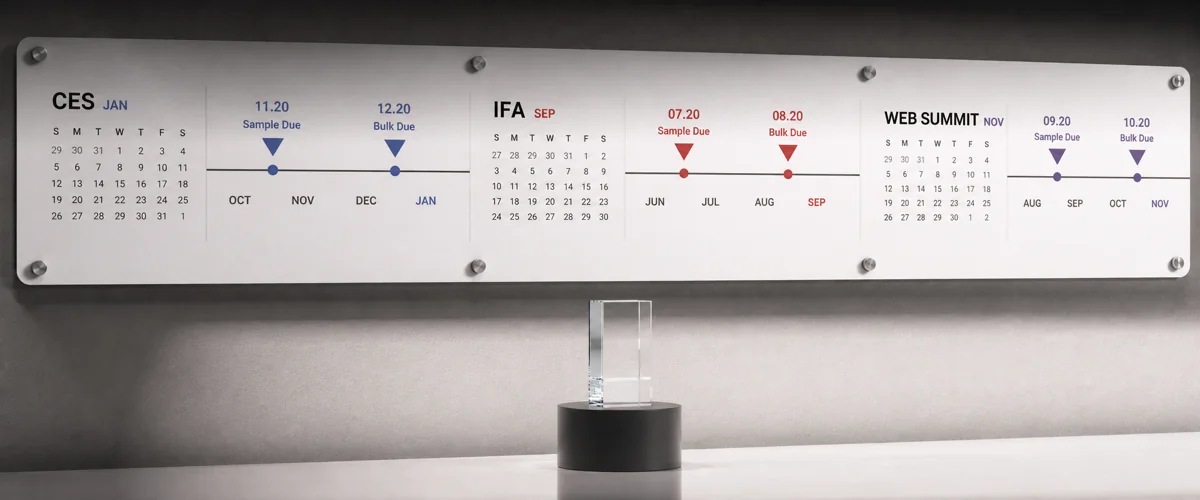
For a new Wetop design, start with 3–5 days for the paid sample and 15–20 days for mass production after written approval and deposit. Approval and transport sit outside those ranges. A need-by date that cannot contain those stages requires a changed scope, split delivery, or another sourcing decision; it is not evidence that the stages can safely disappear.
Sample-to-Bulk Timeline at a Glance
| Stage | Planning baseline | Buyer action | Gate to the next stage |
|---|---|---|---|
| RFQ and sample kickoff | Project-specific | Send final drawing, artwork, material, finish, quantity, destination, and date | Quote and sample specification accepted |
| Paid sample | 3–5 days at Wetop | Confirm receiver and reserve review time | Sample completed and dispatched or reviewed by agreed method |
| Buyer approval | Buyer-owned | Approve in writing or issue a marked revision | Approved sample/drawing and deposit condition satisfied |
| Mass production | 15–20 days at Wetop after approval and deposit | Avoid uncontrolled revisions | Production and 100% inspection completed |
| Packing and export handling | Quote-specific | Confirm labels, consignee, documents, and Incoterm | Freight handoff documents complete |
| Transport, customs, last mile | Dated carrier quote | Ensure importer and booth/warehouse can receive | Delivered before the booth-setup buffer expires |
The non-negotiable controls are specification, production release, inspection, and a feasible transport chain. Approval review can be organized faster, and freight mode can be upgraded, but neither action makes an unapproved design or unfinished production complete.
Sample Stage — Plan the Canonical 3–5 Day Window
Wetop’s published sample window is 3–5 days. The quote should state what starts the clock and whether special material sourcing, color matching, print trials, hardware, or external test evidence sits inside or outside it.
Clear stock material and a simple routing may fit the shorter end; custom color, printing, special hardware, or additional validation may use the longer end or require a separate quoted allowance. Do not simplify a requirement solely to claim a shorter sample date without confirming the delivered appearance and function remain acceptable.
Approval Window — Why “Fast Turn” Buyers Cause Their Own Delays
Approval time is buyer-owned and sits between sample review and production release. Do not assume a fixed buffer. Decide who can approve dimensions, color, artwork, finish, and packing, and record whether one sign-off covers all fields.
An approval can cross departments and time zones: the design lead reviews the sample, marketing changes the logo position, and procurement waits for confirmation. Each revision may affect artwork, programs, fixtures, or a new sample. Put the decision owner and response deadline on the project schedule before dispatch.
What works: name the approver before the sample ships, reserve review time for the expected arrival, and treat the approval review as a release gate rather than a soft task.
The other trap is requesting changes that re-trigger sample stage. A change to dimensions or thickness is a new sample. A change to print color or logo placement can usually be applied directly to bulk if the rest of the spec is approved. Knowing which is which before you write the email back saves a day. For the full list of fields to lock before sample kickoff, see our acrylic RFQ guide — the 9-field checklist is the same one I use to scope a rush.
Tooling Reuse — Confirm the Asset Before Claiming a Saving
Tooling and pre-production can include fixture setup, programming, material allocation, and a proof cut. A retained asset may reduce some engineering work, but the quote must identify the asset and show which stage changes; Wetop has no published two-day saving that applies to every tray.
Trade-show acrylic trays may share rectangular formats, but dimensions alone do not prove fixture compatibility. Material thickness, bend or bond geometry, print registration, tolerances, and finish can change the routing. Ask the supplier to inspect the retained asset against the current revision.
What does not fit modular tooling: trays with unusual aspect ratios, multi-tier designs, integrated dividers cut from the same blank, or any thermoformed shape. For these we build a one-off jig and the 3-day tooling stage holds. The check we run on day zero of a rush quote is whether your tray geometry maps to a jig we already have.
For a repeat season, send the prior PO, approved drawing, and an explicit change list. Reuse is project-specific; put retention, ownership, condition, revision control, and any repeat charge in writing.
Freight Math — Price the Deadline With Dated Quotes
Air, express, sea-air, LCL, and ocean services differ by packed dimensions, chargeable weight, lane, season, customs terms, and carrier. Obtain dated quotes after the packaging plan is known and compare arrival at the actual booth or advance warehouse, not only port transit.
Use this comparison format with current quotes:
| Method | Quoted transit | Quoted cost | Door-to-door assumptions | Risk to verify |
|---|---|---|---|---|
| Sea freight (LCL) | Request | Request | Origin handling, consolidation, port, customs, last mile | Cutoffs, congestion, deconsolidation |
| Sea-air combination | Request | Request | Transfer point, customs path, final carrier | Handoff and missed connection |
| Air freight | Request | Request | Chargeable weight, airport handling, customs, last mile | Space confirmation and dimensional weight |
| Express parcel | Request | Request | Piece limits, duties, consignee availability | Oversize surcharges and customs hold |
The comparison is the freight upgrade versus the buyer’s documented cost of missing the show. Use the actual booth, travel, staffing, replacement, and opportunity costs rather than a generic event budget.
Air freight cannot recover unfinished production, an unresolved approval, missing import documents, or a consignee that cannot receive. Choose the mode from a feasible production-release date and keep a receiving buffer before booth setup.
According to the IATA TACT freight forecast 20261, airfreight rates on the Asia-North America trade lane have stabilized after 2024 volatility — the freight quote you get on day one is more likely to hold through ship date than it was during the 2021-2023 cycle.
Six Schedule Scenarios to Model Before Release
Model at least six schedule risks before release: an incomplete drawing, a late artwork file, a custom-color material lead, a sample revision, a retained fixture that fails revision parity, and a freight quote that expires or misses a cutoff. Assign an owner, latest decision date, fallback, and schedule consequence to each.
The most useful buyer action is to name the approver and reserve review time before the sample ships. For a worked example of how a custom tray specification is built end to end, see our bespoke acrylic tray with artwork integration case study.
Putting the Acrylic Tray Production Timeline Together
The acrylic tray production timeline is a sequence of defensible gates: complete the spec, plan the 3–5 day sample, lock an approver, confirm any reusable assets, allow 15–20 days for mass production after approval and deposit, preserve 100% inspection, and budget transport from a dated quote.
The procurement principle here is critical-path management: identify the longest sequential chain of dependent activities, protect every gate, and accept that compressing a non-critical task does not recover time from unfinished sample, approval, production, or freight work.2
For a first-time custom project, start early enough to contain the quoted sample, approval, 15–20 day production window, and door-to-door transport plus receiving buffer. Work backward from booth setup and reject any schedule that omits a named stage.
The Schedule Fields to Put in the PO
A trade show acrylic deadline becomes manageable when the quote and PO define the clock the same way. Put these fields in writing before release:
- Need-by event. State the booth-setup date, local time zone, delivery address, receiving hours, advance-warehouse rules, and the last date a carrier can book a delivery appointment.
- Sample start condition. Name the payment, drawing, artwork, color reference, material, and hardware inputs required before the 3–5 day sample window begins.
- Approval authority. Identify one person who can approve dimensions, material, finish, construction, branding, and packing, or list the separate owners and the final consolidator.
- Production release. Record the approved drawing revision, approved sample identifier, deposit condition, quantity, and explicit statement that later revisions change the schedule.
- Production finish condition. Define whether 15–20 days ends at fabrication, inspection completion, packing completion, or freight handoff. Wetop’s planning language should be read as mass production after sample approval and deposit, with shipping additional.
- Inspection and evidence. Name the 100% inspection criteria, approval records, carton markings, packing photos, and any third-party inspection hold point.
- Transport basis. State Incoterm, carrier or forwarder, service level, chargeable weight and packed volume, customs responsibility, quoted validity, and planned delivery buffer.
- Fallback. Decide before production whether a split shipment, partial air upgrade, simplified packing, alternate delivery address, or event-local substitute is acceptable if a named milestone slips.
Use milestone dates with owners rather than “ASAP.” The phrase does not tell engineering which revision controls, does not tell production when release occurred, and does not tell the forwarder which service has been approved. A clear critical path gives each party a date they can accept, reject, or re-plan while there is still time to act.
If your show date is fixed, send the booth-setup date, tray drawing, finish, branding, quantity, approval contact, and destination through our contact form. The quote should separate sample, buyer approval, production, inspection, packing, and transport. For customization options that affect the timeline, see our customization overview.
Related guides
- FOB vs DDP: Which Term Fits Your Acrylic Order?
- Acrylic Protective Film: Shipping & Display Floor Life
Footnotes
-
IATA TACT Rules and Air Cargo Tariffs — The International Air Transport Association publishes the TACT (The Air Cargo Tariff and Rules) reference data used industry-wide for air-freight rate planning. The 2026 forecast covers Asia-North America and Asia-Europe trade lanes that matter most for rush acrylic freight from Shenzhen. ↩
-
ASCM CSCP — Certified Supply Chain Professional — The Association for Supply Chain Management’s CSCP body of knowledge covers procurement timing, critical-path management, and rush-order economics that underpin the trade-show acrylic deadline framework. Useful reference for procurement teams formalizing their rush-order playbook. ↩
Frequently Asked Questions
What is the fastest realistic acrylic tray production timeline before a trade show?
For a new custom design, plan from Wetop's normal 3–5 day sample window plus buyer approval, then 15–20 days for mass production after approval and deposit. Add inspection, packing, export handling, freight, customs, and last mile. The quote must state calendar or working days and the start condition for each stage.
Can I skip the sample step to make a trade-show acrylic deadline?
Do not skip it on a new custom design merely to recover time. For an unchanged reorder, the supplier may use the last approved reference only after revision parity and retained assets are confirmed. State in writing whether a new sample or written waiver governs the production release.
How much does air freight add to a rush acrylic order?
There is no reliable generic premium. Ask the forwarder or supplier for dated air, express, sea-air, LCL, and ocean options using the packed weight and dimensions, destination, customs terms, and required delivery date. Compare the upgrade with the buyer's documented cost of a late arrival.
Why do buyers cause more delay than the factory on rush orders?
Approval can become a critical-path delay when artwork, dimensions, color, or branding must circulate internally. Name one final approver, reserve review time before the sample arrives, and define how revisions affect the production-release date.
What information do I need for a trade-show deadline quote?
Send the booth-setup date, destination, tray drawing and tolerances, material and thickness, color and finish, branding files, quantity, packing needs, approval contact, and acceptable freight modes. The quote should show the critical path and schedule assumptions.
Trade-show date locked? Send the brief.
Send the booth-setup date, destination, drawing, finish, branding, quantity, and approval contact. We will quote sample, approval assumptions, production, inspection, packing, and transport as separate stages so the critical path is visible.