What Is Acrylic Fabrication? 6 Steps
Acrylic fabrication turns PMMA sheet into custom products without an injection mold. The useful question is where sheet fabrication fits, and where it does not.
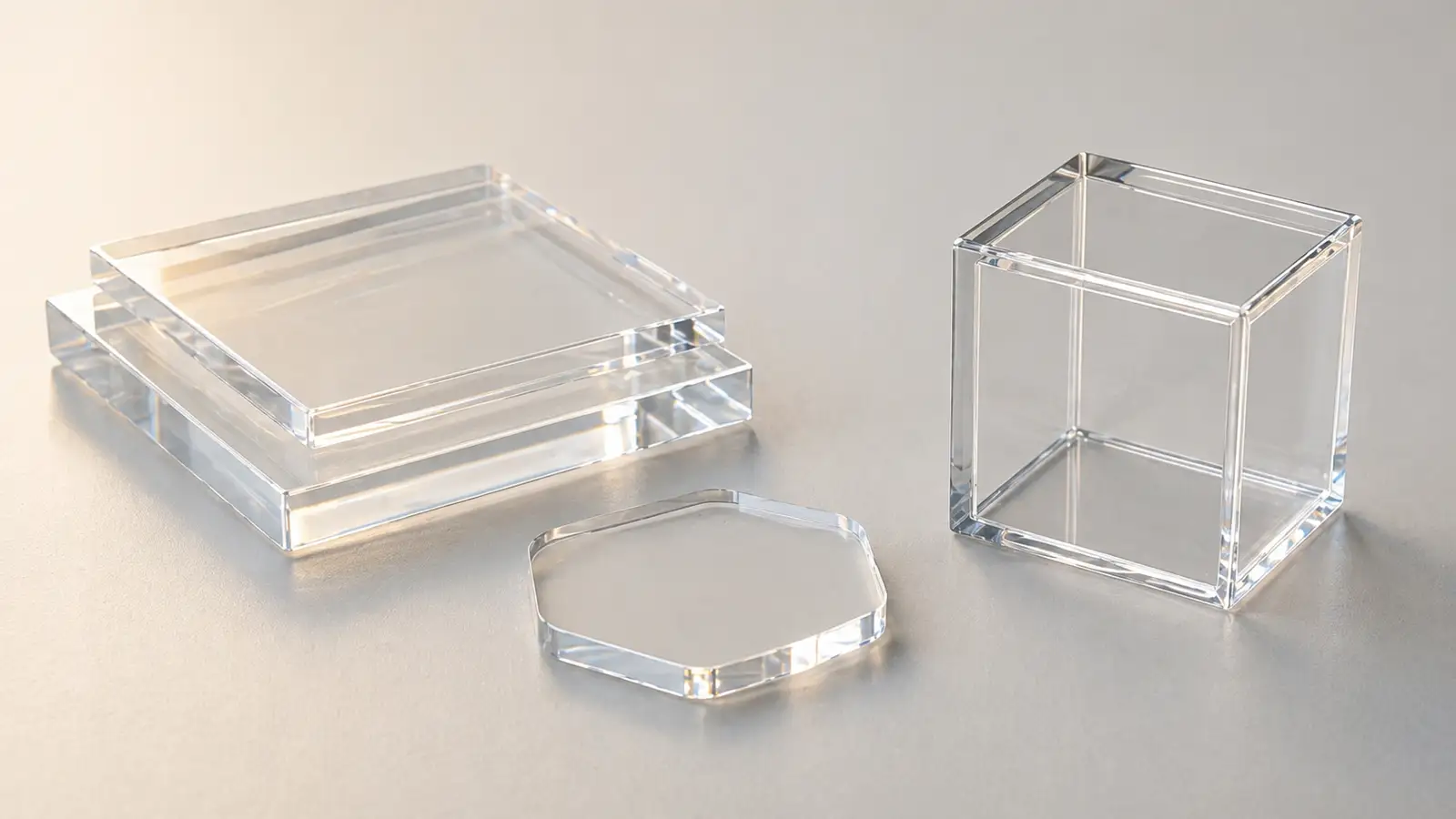
Key Takeaways
- Acrylic fabrication cuts, shapes, finishes, and assembles PMMA sheet, sold under names such as plexiglass and Perspex, into finished custom products. It is fabrication, not injection molding.
- Six core steps run on every project: cut, edge-finish, print or decorate, bend or thermoform, bond or assemble, and inspect. A real acrylic fabricator runs all six in-house; a stock supplier runs none.
- For Wetop's B2B work, sheet fabrication normally fits custom runs from 100 to tens of thousands of pieces. Fixed designs at very high volume should also be evaluated for injection molding.
- A common buyer mistake is sending a sheet fabricator a part designed around molded undercuts, ribs, or zero-radius internal corners. Those features need redesign before production.
- Brief a fabricator with the end use, optical-clarity expectation, planned production quantity, and approved file. Those inputs determine material grade, edge specification, finish, and price.
On this page
- What Is Acrylic Fabrication? The 30-Second Answer
- Where the Word “Acrylic” Comes From, and Why It Matters for Fabrication
- The 6 Core Steps of the Acrylic Fabrication Process
- Who Buys Acrylic Fabrication Services
- Acrylic Fabrication vs Injection Molding vs Glass vs Metal
- Common Buyer Mistakes When Briefing an Acrylic Fabricator
- When Do You Need a Custom Acrylic Fabricator vs a Stock Supplier?
What Is Acrylic Fabrication? The 30-Second Answer
Acrylic fabrication turns flat acrylic sheet (PMMA, sold as plexiglass or Perspex) into a finished custom product by cutting, edge-finishing, printing, bending, bonding, assembling, and inspecting it. It starts with cured sheet rather than melted pellets in a closed injection mold. Forming tools or jigs may still be needed for some shapes.1
The distinction matters at the RFQ stage. A stock supplier sells a finished catalog item. A sheet fabricator builds your geometry from PMMA sheet. An injection molder builds around a dedicated mold. This guide shows the six fabrication operations, the buying situations that suit them, and the design details that need attention before a quote.
Where the Word “Acrylic” Comes From, and Why It Matters for Fabrication
Before we go deeper into what is acrylic fabrication on the shop floor, the language is worth pinning down. Acrylic is the everyday name for polymethyl methacrylate (PMMA), a clear thermoplastic first commercialized in the 1930s. PMMA is the technical polymer name; “acrylic,” “plexiglass,” and “Perspex” are the trade and consumer names that stuck. All four words refer to the same material that shows up at an acrylic fabrication shop as flat sheet stock.
PLEXIGLAS records Otto Röhm and his research team’s 1933 registration of the PLEXIGLAS brand for PMMA.2 “Plexiglass” later became a common US term, while Perspex remains common in the UK and Commonwealth markets. Technical drawings and material datasheets use PMMA. These names do not describe different base polymers, although sheet grade, casting method, additives, color, and surface finish can still differ.
For the two main sheet-production routes, see our guide to cast vs extruded acrylic.
The 6 Core Steps of the Acrylic Fabrication Process
The acrylic fabrication process uses six core operations: cut, edge-finish, print or decorate, bend or thermoform, bond or assemble, and inspect. A flat sign may skip bending, while an unprinted component skips decoration. Cutting and inspection remain. For equipment, tolerance, finish, and cost drivers, see the six core acrylic fabrication techniques.
Step 1: Cut. Sheet stock is loaded onto a CO2 laser cutter for clear cuts on cast acrylic, or a CNC router for thick stock, internal pockets, and machined edges. The cutter follows a DXF, AI, or PDF vector file and produces flat blanks to the approved dimensions. Step 2: Edge-finish. Laser-cut cast acrylic can leave a clear edge. CNC-cut edges are matte and need diamond or flame polishing when the edge remains visible.
Step 3: Print or decorate. If the part carries a logo, color, or graphic, this is where it goes on. The three common methods are UV printing (full-color, photographic detail), silk-screen (flat color, durable), and laser engraving (permanent, etched into the surface). Step 4: Bend or thermoform. Strip-heating bends a single line for a sign holder or brochure stand. Thermoforming softens the sheet over a male or female tool for compound curves and domes. Step 5: Bond or assemble. Solvent cement joins cases, boxes, and risers; mechanical fasteners handle serviceable assemblies. Step 6: Inspect. Every piece is checked against the approved sample for dimensions, clarity, edge quality, and print registration. Wetop records that inspection within its ISO 9001 quality system.3
For a deeper walk-through of how this six-step flow runs on our specific factory floor, see our manufacturing process page.
Who Buys Acrylic Fabrication Services
The buyers we ship to fall into four broad categories: retail and brand-merchandising teams, packaging and gifting brands, signage and wayfinding companies, and award and trophy makers. Each category has slightly different priorities, but the fabrication process underneath is the same.
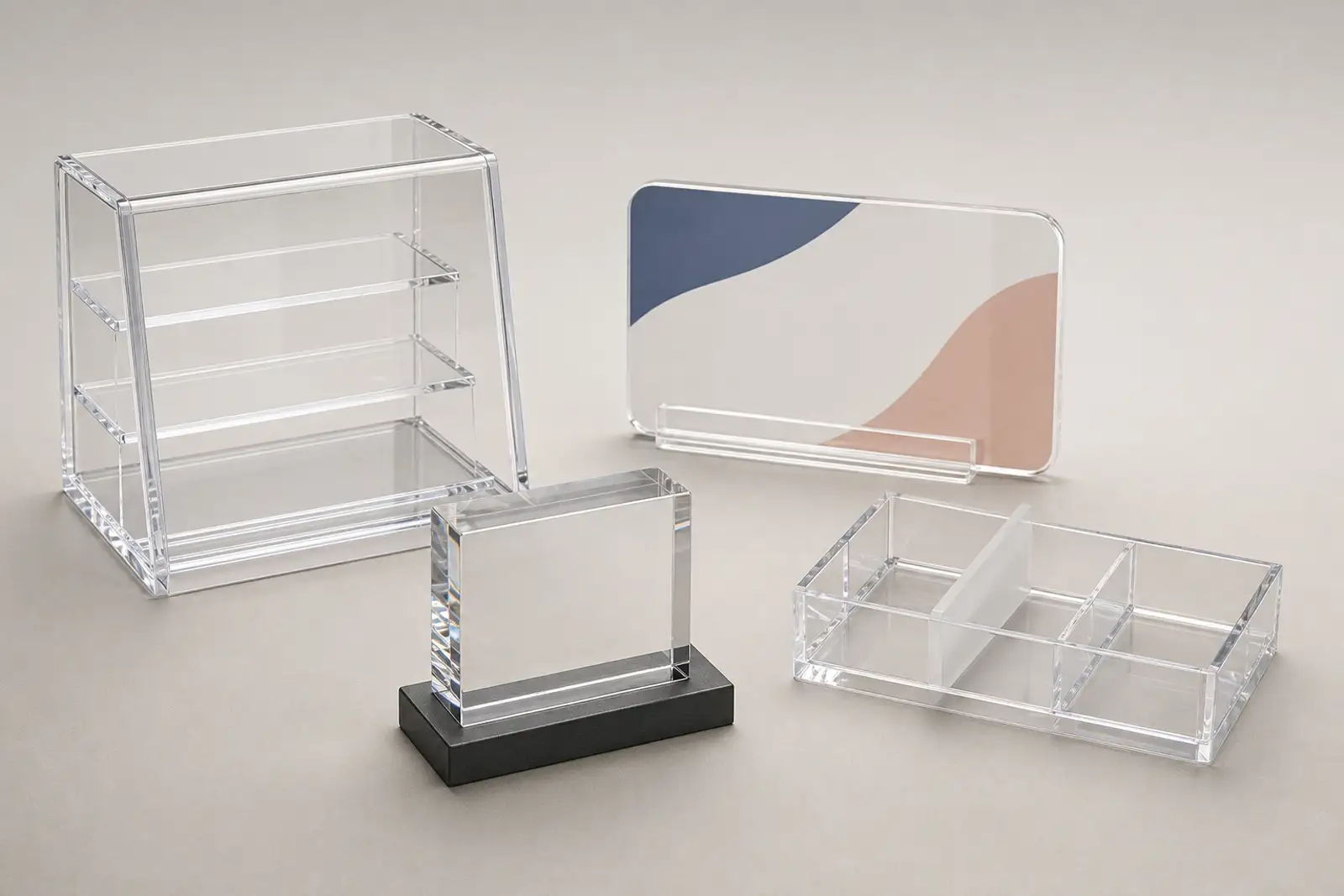
Retail and brand-merchandising teams buy countertop stands, floor units, in-aisle headers, shelf-edge sign holders, and trade-show displays. The brand owns the design; the fabricator repeats it across the rollout. Optical clarity, brand-color accuracy, and batch consistency control the brief. See our POP and POS displays application page for this segment. Packaging and gifting brands buy clear boxes, presentation cases, watch boxes, and fitted product containers. Visible edges and joints often matter more than they do on an internal component.
Signage and wayfinding companies buy laser-cut letters, backlit signs, and mounting panels. Edge quality and lettering precision control how the sign reads from a distance. Award and trophy makers buy blocks, plaques, engraved awards, and UV-printed pieces. Optical clarity through a thick block matters because internal marks reveal haze and edge defects. Across these categories, I hear the same buyer question: can the bulk order match the approved sample? Browse our acrylic displays and acrylic cases to see the main product paths.
Acrylic Fabrication vs Injection Molding vs Glass vs Metal
Acrylic fabrication is one of four common methods to produce custom transparent or display-grade hard parts. The decision between acrylic fabrication, injection molding, glass fabrication, and sheet-metal fabrication turns on quantity, geometry, and the role optical clarity plays in the finished product. Understanding the contrast is the fastest way for a buyer to confirm that acrylic fabrication is actually what the project needs.
| Method | Tooling cost | Economical quantity | Best when… | Not great when… |
|---|---|---|---|---|
| Acrylic fabrication | Usually low; forming tools may add cost | 100 to tens of thousands | Custom geometry, optical clarity, low-mid volume | Very high volume with a frozen moldable design |
| Injection molding (PMMA pellets) | High, project-specific mold cost | High-volume repeat production | Frozen, moldable design at very high volume | Custom low-volume work; design changes after tooling |
| Glass fabrication | Near zero | Any | Highest scratch resistance, premium feel | Weight, breakage risk, shipping cost |
| Sheet metal fabrication | Usually low | 100+ pcs | Structural strength, no transparency needed | Anywhere optical clarity matters |
Acrylic fabrication vs injection molding. Both can end with a PMMA part, but the production logic is different. Injection molding uses a dedicated closed mold and runs quickly once that tool is approved. Fabrication starts with cured sheet and keeps the geometry easier to revise. Ask for both quotes when the design is fixed and volume is high enough that mold cost may be recovered through lower unit labor.
Acrylic fabrication vs glass fabrication. Acrylic is lighter and more impact resistant, which usually lowers breakage risk for shipped retail displays and signs. Glass is the better choice when scratch resistance, surface feel, or high-temperature performance controls the brief. Acrylic fabrication vs sheet metal fabrication. Metal belongs in load-bearing frames, chassis, and brackets. Acrylic belongs where transparency, light transmission, color, or lower weight matters. Many retail fixtures use both: a metal frame for load and fabricated acrylic for the visible face.
Common Buyer Mistakes When Briefing an Acrylic Fabricator
Five mistakes recur in acrylic-fabrication RFQs. Each is preventable before quoting.
1. Sending a part designed for injection molding. Molded parts often have undercuts, draft angles, internal ribs, and zero-radius internal corners. Sheet fabrication cannot reproduce all of them without redesign. Use flat panels, workable internal radii, and accessible joints. 2. Not specifying the acrylic grade. “Acrylic, 5 mm thick” is incomplete. Cast and extruded sheet can behave differently during machining, polishing, bonding, and chemical exposure. Specify the sheet route and, when required, an approved material brand or datasheet.
3. Confusing fabrication with stock supply. Some suppliers distribute finished stock parts rather than make them. Ask who controls the cut method, edge finish, bonding method, and thickness tolerance. 4. Skipping the sample. Polish gloss, bend radius, print color, joint appearance, and hardware fit are hard to settle from a quote. Wetop’s paid samples normally take 3–5 days. Approve one before production. 5. Quoting the sample quantity as the production quantity. A sample is a validation step, not a sub-MOQ production run. Wetop’s standard production MOQ is 100 pieces per design. If the total requirement is lower, a stock part or local fabricator is usually the better route.
When Do You Need a Custom Acrylic Fabricator vs a Stock Supplier?
You need a custom acrylic fabricator the moment any of these is true: the dimensions are not in a catalog, the shape is not a standard rectangle, the part needs your branding, the part needs a specific edge or surface finish, the part needs to integrate with another component (LED, magnet, hinge, mounting hole), or the project will be reordered with consistent specifications. If none of those is true, a stock supplier is faster and cheaper, and an acrylic fabricator is the wrong tool for the job.
Most RFQs I review become custom for a practical reason: the brand needs its logo, the retailer needs an exact shelf fit, or the product needs a specific block thickness and engraving. The 50-store retail display rollout shows this at program scale. Stock products still work well for standard shields, catalog-size sign holders, and simple boxes with no fitted hardware or branding. I recommend stock when it meets the specification; fabrication should earn its extra setup through fit, finish, function, or repeatability.
The first four items I check are the end use, optical-clarity expectation, planned production quantity, and design file or dimensioned sketch. Those inputs control the sheet grade, thickness, edge specification, finish, packaging, and price. Wetop responds within 24 hours. Send the file through the customization page or use the custom acrylic fabrication quote page when the job involves CNC, laser cutting, bending, polishing, or assembly.
Footnotes
-
Society of Plastics Engineers; Thermoforming and Fabrication Division; professional engineering society for plastics processing, covering fabrication methods, material selection, and industry technical standards relevant to PMMA sheet fabrication. ↩
-
PLEXIGLAS history: the brand owner’s history records Otto Röhm and his team’s 1933 development and registration of PLEXIGLAS. ↩
-
ISO 9001 quality management: the quality-management standard under which Wetop controls inspection records and corrective actions. ↩
Frequently Asked Questions
What is acrylic fabrication in simple terms?
Acrylic fabrication turns flat acrylic sheet (PMMA, also sold as plexiglass or Perspex) into a finished display, case, sign, organizer, award, or component. The main operations are cutting, polishing, printing, bending, bonding, assembly, and inspection. It differs from injection molding, which melts pellets inside a closed mold, and from buying a stock catalog item.
What does an acrylic fabricator actually do?
An acrylic fabricator reviews the design, selects the PMMA sheet, cuts it by laser or CNC, finishes the edges, adds print or engraving, forms bends when required, bonds or assembles the parts, and inspects the finished product. Wetop runs these operations in one 5,000 m² Shenzhen facility with 8 laser cutters, 4 CNC machines, and a diamond-polishing line.
Is acrylic fabrication the same as injection molding?
No. Acrylic fabrication starts with cured sheet and cuts, heats, or bonds it into shape. Injection molding melts PMMA pellets and forces the material into a closed mold. Fabrication usually avoids a steel injection mold, although bending jigs or thermoforming tools may still cost money. Wetop's standard production MOQ is 100 pieces per design; fixed shapes at very high volume should also be quoted as molded parts.
When should I use a custom acrylic fabricator instead of buying stock?
Use a custom acrylic fabricator when the required dimensions, branding, finish, hardware, or geometry are not available off the shelf. Stock products are usually better for standard clear boxes, sign holders, and shields. A custom size, printed logo, LED channel, fitted insert, unusual edge finish, or repeatable multi-part assembly points to fabrication.
How much does custom acrylic fabrication cost?
Cost depends on sheet grade and thickness, dimensions, the number of cuts, bends and bonded joints, finish, hardware, packaging, and quantity. A flat laser-cut part is cheaper than a thermoformed, printed, LED-integrated assembly. Send the design and planned production quantity for a line-item quote within 24 hours.
Have a Real Acrylic Project to Fabricate?
Send your drawing or reference image, dimensions, quantity, and finish requirements. We will review the fabrication route and return a line-item quote within 24 hours.