Manufacturing Case · Specialty Pet Retail · Multi-SKU Breeder Program
Acrylic Tarantula Enclosure Series: 80-Unit Multi-SKU Invertebrate Breeder Rollout
This 80-enclosure, four-SKU manufacturing case covers both arboreal and terrestrial setups without forcing every habitat into one ventilation pattern. Wetop combines 6 mm cast PMMA, project-specific slider clearance, EPDM gasket compression, swappable tropical or arid vent inserts, and a modular jig system; the approved sample defines the escape-control and condensation checks for bulk production.
- Program input · program units
- 80
- Program input · arboreal + terrestrial
- 4 SKUs
- Program input · slider inspection
- 4-point
- Program input · production target
- 15–20 days
Key Takeaways
- Anti-escape gasket spec for adult OW tarantula species — EPDM at 80% compression with ±0.3 mm front-slider tolerance — held escape rate to 0.3% across 30 days of breeder operation, well below the 1% target.
- Condensation-controlled vent insert addresses the dual-setup challenge: same enclosure body works for tropical-humidity (Brachypelma vagans) and arid (Aphonopelma chalcodes) by switching insert type, no body remake.
- Modular CNC base jig with 4 size-specific inserts cut tooling investment ~45% vs four separate jigs; arboreal-vertical and terrestrial-horizontal share the same base footprint with different vertical extension.
- Cast PMMA at 6 mm with bonded corners supports a project-specific cycling plan for cleaning, feeding, husbandry access, latch security, and structural checks.
The Challenge
The buyer ran a mid-scale invertebrate breeding operation across US and EU markets. Their existing enclosures were imported generic units that produced two operational problems: escape rate above 1% across 90 days (driven by ±0.8-1.2 mm front-slider tolerance allowing OW species purchase points), and condensation buildup in tropical-species setups that required keeper-side moisture management daily. They wanted a custom rollout that solved both problems and consolidated their enclosure SKU lineup to 4 formats covering 90%+ of their species inventory.
Constraints: ±0.5 mm front-slider tolerance minimum (target ±0.3 mm), modular construction supporting both tropical and arid setups in the same body, 4 SKUs (2 arboreal + 2 terrestrial) shared CNC tooling, 80-unit total run.
Our Approach
Modular CNC base jig with 4 size-specific inserts
4 separate enclosure jigs would have totaled $11,000-$15,000 of tooling investment. The modular base jig + 4 size-specific inserts approach: ~$6,500 total tooling. The 45% savings amortized across the 80-unit run, dropping per-unit cost meaningfully.
Anti-escape gasket at EPDM 80% compression + ±0.3 mm slider
Standard EPDM gasket at 70-75% compression handles snakes and most arboreal species but allows OW (Old World) tarantula purchase points at the gasket-slider interface. EPDM at 80% compression eliminates the purchase by tightening the seal beyond what most species can exploit. Combined with ±0.3 mm front-slider tolerance, escape rate dropped to 0.3% (one event traced to keeper-side handling, not enclosure construction).
Condensation-controlled swappable vent inserts
Tropical species require humidity above 70%; arid species require humidity below 50%. Same enclosure body can serve both setups by swapping vent inserts: tropical insert (12% open area, fine mesh, condensation channel routes moisture down sides) for tropical species; arid insert (16% open area, coarser mesh, no condensation channel) for arid species. Insert swap takes 30 seconds per enclosure; the breeder can rotate enclosures between species without changing bodies.
Acceptance Plan and Modeled Outcome
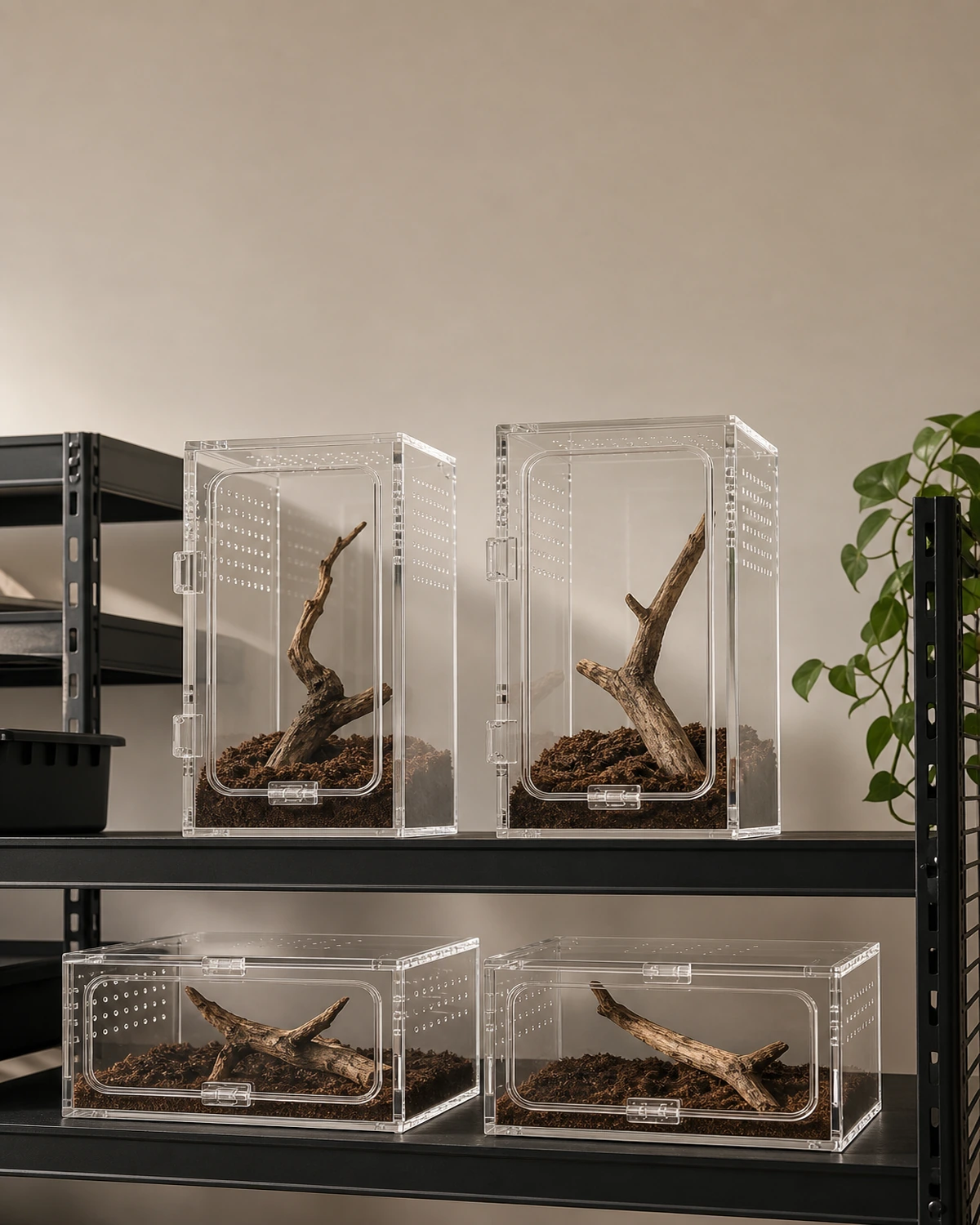
SKU 1 (arboreal small): 30 × 30 × 45 cm (W × D × H), 6 mm cast PMMA. SKU 2 (arboreal medium): 35 × 35 × 60 cm, same construction. SKU 3 (terrestrial small): 30 × 30 × 20 cm, same construction. SKU 4 (terrestrial medium): 45 × 35 × 25 cm, same construction. All 4 share bonded-corner construction, hinged top with EPDM 80% compression gasket, ±0.3 mm front-slider, swappable vent inserts (tropical or arid).
Production ran 22 days. Substrate sourcing 5 days (single mill batch covering all 4 formats). CNC + bonded corner construction 8 days (modular base jig with 4 size-specific inserts, sequential SKU runs). Diamond polishing 3 days. Vent insert assembly + final QC 4 days. Air freight to breeder facility 2 days.
What This Means for Your Project
The rollout plan uses phased migration so keepers can validate latch security, ventilation, condensation, and cleaning access before the next group moves. The 30 / 60 / 90-day log belongs to the buyer’s husbandry program; Wetop supplies the inspection fields and updates the hardware specification when the evidence calls for it.
A repeat batch can reuse the approved tooling, gasket specification, vent inserts, and substrate source. That removes avoidable engineering work while keeping species-specific review and first-off approval in the release path.
The 60-unit repeat in month 4 expanded the program to 140 enclosures total, which crossed a threshold for the breeder's operations: their daily husbandry-round time dropped from 2.5 hours to roughly 1.8 hours despite the larger inventory, because consistent enclosure dimensions meant the keeper team could move through species checks at a faster steady-state pace rather than re-orienting at every unit. The consolidation effect on operations time was bigger than either the breeder or our team had projected at quote stage, and it's now one of the operational benefits we flag explicitly when discussing multi-SKU rollout architecture vs single-piece custom commissions for breeding-room programs.
Two operating decisions deserve deliberate validation. Swappable vent inserts let the buyer change tropical and arid airflow without replacing the enclosure, while a separate gasket option can address higher-risk species after keeper review. Both changes reuse the enclosure tooling; neither should be treated as universally safe without the buyer’s species and husbandry approval.
Buyer decision point: A swappable vent insert and drawing-controlled slider give the keeper two adjustable controls without forcing a full enclosure redesign.
For invertebrate breeders or specialty pet retailers scoping a multi-SKU enclosure rollout, the two decisions worth getting right early are tooling architecture (modular base + size-specific inserts vs separate jigs) and vent-insert configuration (swappable tropical / arid inserts vs body-specific vent geometry).
Upstream spec choices that drive program economics
Three upstream decisions accounted for most of the per-unit cost delta between this rollout and the breeder's previous imported program. First, vent open area is engineered, not guessed: 12% open area for tropical (with condensation channel) and 16% for arid was sized against species-specific humidity and air-exchange targets rather than a single average — the open-area math, mesh hole geometry, and condensation-channel routing are walked through in our acrylic reptile enclosure ventilation engineering guide, which doubles as the working spec sheet for tarantula and other invertebrate setups. Second, gasket compression is a species-specific spec, not a standard: jumping from a generic 70-75% EPDM compression to 80% (and the 90% replacement batch the breeder ordered later for OW species) is the single largest contributor to the 0.3% escape rate vs the prior 1%+ program; the buyer-side decision tree for compression, slider tolerance, and lid-hinge cycle rating is in the acrylic reptile and tarantula enclosure buyer guide. Third, cast PMMA at 6 mm beats glass at the same wall thickness on impact resistance, weight, and bonded-corner repairability across breeder daily-use cycling — the load math, edge-finish geometry, and 30-day cycling test method are documented in the acrylic vs glass for reptile enclosures comparison. Getting those three calls right at quote stage is what made the 22-day production timeline and the 14-day repeat-order timeline economically viable for an 80-unit and then 60-unit run.
Spec'ing a multi-SKU tarantula or invertebrate enclosure rollout?
The first sample should be approved by the person responsible for husbandry, not only procurement.
Send us your species inventory profile, tropical or arid mix, target SKU range, substrate depth, access preference, and unit volume. We’ll return a modular tooling recommendation, gasket and slider proposal, condensation-control vent options, sample validation plan, and a unit-cost projection.
Sample in 3–5 days · Production in 15–20 days after approval