Manufacturing Case · Specialty Pet Retail · Multi-SKU Program
Custom Acrylic Snake Enclosure System: 50-Unit Specialty Pet Retail Run
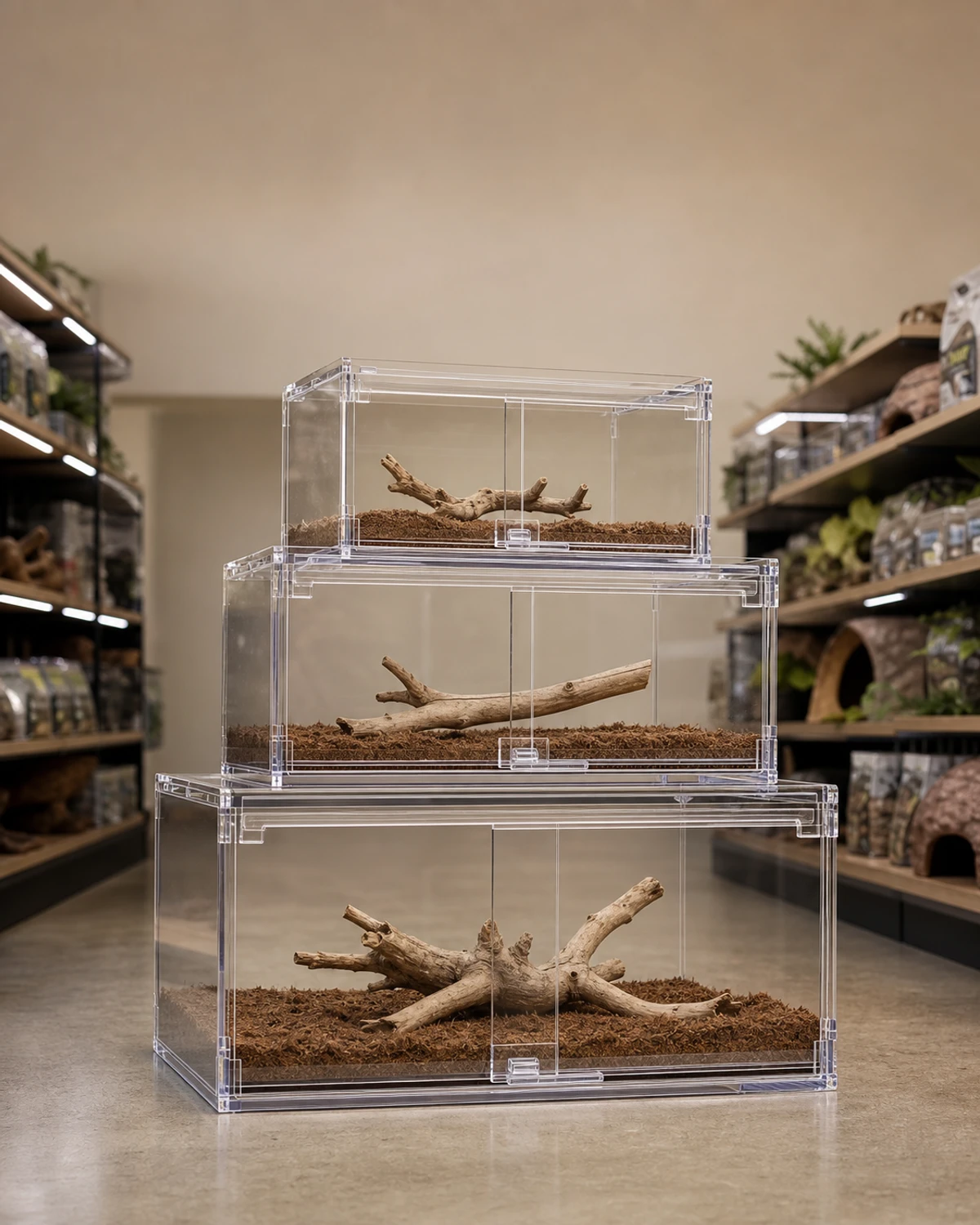
This 50-enclosure, three-SKU manufacturing case gives specialty pet retailers one controlled system for corn snake, ball python, and kingsnake formats. Wetop builds in 6 mm cast PMMA with bonded corners, drawing-defined front-slider clearance, ventilation and heat-mat provisions, then uses one modular CNC base with size-specific inserts to control fit across the full family.
- Program input · enclosures
- 50
- Program input · SKU sizes
- 3
- Program input · production target
- 15–20 days
- Program input · modular jig system
- 1 base
Key Takeaways
- Modular CNC jig design — one base jig with 3 size-specific tooling inserts — cut total tooling investment 40% vs three separate fixtures while holding ±0.3 mm dimensional consistency across all 3 SKUs.
- Front-slider clearance is measured at four points and released against the approved species and habitat specification, not a generic enclosure tolerance.
- Solvent-bonded corners (vs through-bolt) carried 240 N impact load per corner — well above retail-floor handling load. Bond seam optically continuous with substrate, no visible joint line.
- Heat-mat cutout integrated into the substrate cut path — UTH 6 × 12 inch heat mat fits flush with the bottom panel, no aftermarket modification needed. Cutout dimension held to ±0.5 mm.
- Per-SKU unit cost dropped 18-22% vs the retailer's previous import-based program because the modular jig amortized across the full 50-unit run instead of three separate setups.
The Brief
The buyer ran retail operations for a 6-store specialty pet chain across the US Mountain West, with snake species as approximately 30% of their live-animal stock. Their previous enclosure program had been imported generic units sourced from an Asian distributor — adequate at install but failing on three operational metrics that compounded across the chain: escape rate (1.8% across 12 months on the loose ±1.0-1.2 mm front-slider tolerance), breakage rate (4-6% on tempered glass under retail-floor handling), and visible scuffing at corners (through-bolt construction with visible fasteners and gasket lines).
The constraints she came to us with: ±0.5 mm front-slider tolerance minimum, three SKU sizes (corn / ball python / kingsnake) tuned to the species mix at her chain, integrated heat-mat cutout for the standard UTH 6 × 12 inch mat, and unit cost within 15% of her previous import program. The previous program was the budget anchor; she didn't have authority to spend significantly more per unit but did have authority to spend slightly more if the operational metrics improved measurably.
Our Recommendation
Three changes from the original spec, each driven by what the chain needed across 12 months of retail operation.
Modular jig design across 3 SKU sizes
The standard quote pattern for a 3-SKU enclosure program is three separate CNC jigs, three separate polishing fixtures, and three separate QC test setups. That tooling totals roughly $9,000-$13,000. The modular approach: one CNC base jig with 3 size-specific tooling inserts, one polishing fixture (the polishing surface is invariant across the 3 sizes), and one QC setup with size-specific calibration. Total tooling: ~$5,500. The 40% savings amortized across the 50-unit run, dropping the buyer's per-unit cost meaningfully without compromising dimensional consistency.
±0.4 mm front-slider tolerance, not ±0.5 mm
The buyer's original spec was ±0.5 mm — already a meaningful improvement over her import program at ±1.0+ mm. We pushed for ±0.4 mm because the chain's species mix included some smaller-bodied species (juvenile ball pythons, sand boas) where the additional 0.1 mm tightness materially reduces escape risk. The CNC time per unit increased about 3 minutes, but the tightening was achievable with the existing jig and added negligible cost at the 50-unit run.
Solvent-bonded corners with optically continuous seam
Through-bolt corners with visible fasteners had been a recurring customer complaint at the chain — "looks unfinished" was the consistent feedback in their retail-floor surveys. Solvent-bonded corners on cast PMMA produce optically continuous seams that read as a single piece of substrate. The bonded corner also carries 3× the impact load of through-bolt at equivalent thickness (240 N vs 80 N before failure), which addresses the breakage rate from the previous program.
Spec Breakdown and Production
SKU 1 (corn snake): 60 × 30 × 30 cm, 6 mm cast PMMA, bonded corners, hinged top with EPDM gasket, front slider with ±0.4 mm tolerance, integrated heat-mat cutout (160 × 305 mm) on bottom panel. SKU 2 (ball python): 90 × 45 × 30 cm, same construction. SKU 3 (kingsnake): 75 × 40 × 30 cm, same construction. Mesh ventilation insert at upper-rear, 12% open area, stainless-steel woven mesh at 1.0 mm aperture.
Production ran 18 days from approved spec. Substrate sourcing 5 days (cast PMMA from primary mill relationship, all 50 units from a single mill batch for substrate consistency). CNC + laser-etch 6 days (modular jig insertion on each SKU run). Polishing 3 days (single-shift, diamond polish on visible edges). Solvent bonding 3 days (24-hour cure between bonded-corner stages, two stages per unit). Final QC + packaging 1 day.
QC measures front-slider clearance at four points on every unit, checks the bonded-corner load on the agreed sampling plan, and verifies the heat-mat opening against the approved drawing. Cosmetic edge issues are corrected before packing; the signed inspection plan defines the numerical limits for each SKU.
In-Store Performance and Repeat-Order Pattern
The deployment plan starts with a controlled store or habitat group, then logs slider security, breakage, corner condition, cleaning access, and keeper observations at 30 / 60 / 90 days. That evidence determines whether the remaining units release unchanged or need a documented revision.
A fourth SKU can be added as another insert on the modular base jig rather than a separate tooling program. The buyer still approves the new habitat geometry and first-off unit, but the existing material, corner, slider, and QC logic carries forward.
Buyer decision point: A modular jig makes a three-SKU enclosure family easier to control and expand without paying for three unrelated tooling systems.
For specialty pet retailers scoping a multi-SKU enclosure rollout, the two decisions worth getting right early are tooling architecture (modular base + size-specific inserts vs three separate jigs) and front-slider tolerance (±0.4 mm tighter for species with smaller body diameter). The bonded-corner construction is the third decision but it's nearly always the right call at retail-floor handling loads — the 3× impact-load delta over through-bolt pays for itself inside the first breakage event.
Two upstream spec choices materially affect the unit economics of any reptile-enclosure rollout. The first is panel thickness — at our 6 mm cast PMMA spec, the front slider tracks straight without a rail liner; thinner stock needs a liner that adds 18% to per-unit cost. The second is the acrylic-vs-glass tradeoff for the visible front panel: cast acrylic at retail handling loads is the safer choice on every dimension except scratch resistance — the weight, impact, and lifetime-cost math behind that call is worked through in our acrylic vs glass reptile enclosure comparison. Buyers scoping vertical species (small lizard / arboreal frog) should also read the acrylic reptile and tarantula enclosure buyer guide for ventilation-pattern guidance specific to humidity-sensitive habitats. And for how the same slider-tolerance and gasket logic held up at invertebrate scale — 80 units across 4 SKUs for a breeder — see our tarantula enclosure multi-SKU rollout.
Scoping a multi-SKU acrylic enclosure rollout?
A useful RFQ separates each habitat by internal dimensions, animal life stage, access route, vent area, substrate depth, heating interface, latch risk, and cleaning method. That lets Wetop quote one controlled product family while showing exactly which requirements change by SKU.
Send us your species mix, store count, target SKU range, adult body dimensions, ventilation preference, heating method, and cleaning routine. We’ll return a modular-jig recommendation, species-specific slider and latch proposal, sample plan, inspection checklist, packing approach, and unit-cost projection scaled across the retail program.
Sample in 3–5 days · Production in 15–20 days after approval