Clear Acrylic Box for Display vs Lidded Cases — When Each Wins
Most buyers walk into our intake calls asking for an 'acrylic box' when every signal in the conversation says they want a lidded case. Here's the spec language that bridges the gap before the RFQ is locked.
Key Takeaways
- 'Box' and 'case' are often used interchangeably in RFQs, but an open five-panel box and a six-panel lidded case require different hardware, access, inspection, packing, and pricing.
- An open clear acrylic box for display is strongest when staff need frequent access and the item is attended in a controlled, low-dust environment.
- A lidded case becomes more defensible as dust exposure, unattended hours, item value, or theft consequence increases. A lock is a separate decision from adding a lid.
- Price the hinge, latch or lock, joint or gasket, panel thickness, and packing separately. Hardware and assembly can materially change the quote, but there is no universal percentage.
- Do not use generic online unit-price bands for a custom case decision. Compare both forms at the same dimensions, material, quantity, finish, packaging, destination, and Incoterm.
On this page
The vocabulary trap — ‘box’ vs ‘case’ in B2B buying language
Most buyers asking for a “clear acrylic box for display” actually want a lidded display case — they just don’t know the trade vocabulary draws a hard line between the two. An open box is five bonded panels with the top open. A lidded case is six panels plus a hinge, a closing mechanism, and a dust-seal interface. The two forms cost differently, ship differently, and fail differently in the field.
Buyers often use “box” as a general word for a transparent enclosure. A fabricator needs to translate that into an open five-panel form or a lidded six-panel form before pricing. The distinction matters because the lid, hinge, closure, seal, access workflow, and packing change the build. This guide is the translation layer. Its sibling term gets the same treatment in our custom-made acrylic cases buyer guide.
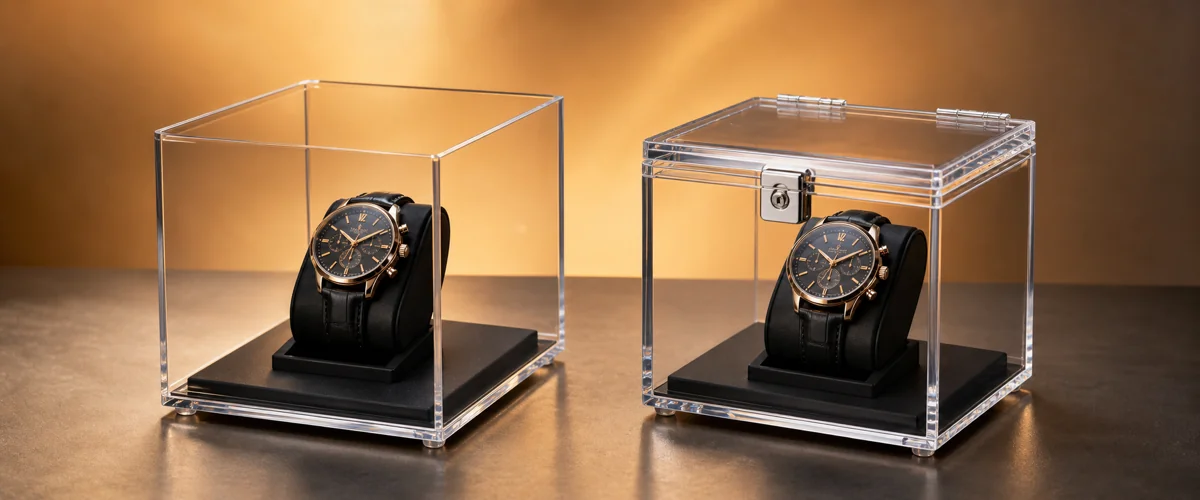
Same merchandised item, two form factors. The vocabulary buyers reach for is “box”; the form most B2B retail use cases need is “case.” Bridging that gap is what this guide does.
The simplest way to break the vocabulary deadlock is to stop arguing about words and look at the merchandised item. Six decision points — dust exposure, theft risk, accessibility frequency, item value, display environment, unit cost ceiling — fully separate the box-correct projects from the case-correct projects. The matrix below is what we run on every intake call before we generate a quote.
Box vs Case: 6-Decision-Point Matrix
| Decision point | Open box wins when… | Lidded case wins when… | Verdict driver |
|---|---|---|---|
| Dust exposure | Display sits in low-dust retail floor, restocked weekly | Display sits in HVAC return zone, public lobby, or open trade-show booth | Environment |
| Theft risk | Behind-counter, attended, low-unit-value SKU | Unattended overnight, mall corridor, high-unit-value SKU | Attendance |
| Accessibility frequency | Staff handles item daily — restock, rotate, demo | Item is replaced monthly or less; access is the exception, not the rule | Workflow |
| Item value | Low replacement consequence | High replacement consequence | Loss tolerance |
| Display environment | Indoor, climate-controlled, controlled retail floor | Outdoor-adjacent, public space, or unsupervised after hours | Exposure |
| Unit cost ceiling | Quote favors simple open construction | Quote supports lid, closure, and added assembly | Spec headroom |
Read the matrix this way. Three or more rows leaning toward “open box wins” and the merchandised application is genuinely a clear acrylic box for display — order the open form, save the spec premium, and let staff workflow run unimpeded. Three or more rows leaning toward “lidded case wins” and the project is a case, regardless of what the buyer typed in the RFQ subject line. The 50/50 splits — usually two rows each side — are where the conversation belongs, and where our quote team produces both options side by side. For a related decision frame on the chemistry (cast vs extruded vs polycarbonate, before form factor), see our cast acrylic vs PETG vs polycarbonate guide.
When an open box is sufficient (and when it bites you)
An open clear acrylic box for display is a strong fit for low-consequence, high-handling, attended merchandising. The form is simpler and often costs less than a comparable lidded case, but the actual gap depends on dimensions, material, quantity, finish, hardware, packing, and freight.
The clearest “open box wins” signal we see on intake is staff workflow. A confectionery retailer rotates promotional candy SKUs every two weeks; staff restock the boxes daily during peak. A lidded case adds a hinge step to every restock — multiply by 200 stores and the chain feels the friction within a quarter. Same logic for fast-rotating shelf merchandising, sample bowls, point-of-sale impulse displays, and any application where the merchandised item is consumable, replaceable, or designed to be touched. We’ve shipped open clear acrylic box for display orders into supermarket chains, dollar-store concepts, and convenience-store impulse-buy programs where the box is genuinely the right form. For the retail-shelf application specifically, our shelf-edge sign holders supermarket case study shows the open-form decision in a live retail program.
An open box is exposed to the environment and gives direct access to the item. If dust, unattended hours, or the consequence of removal is material, include a lidded option in the RFQ and compare it against the open form. For conservation applications, do not infer performance from a retail lid; see our museum-grade acrylic display cases UV spec guide for the additional evidence required.
Do not assume the open box is sufficient on cost grounds alone. Run the matrix and price both forms when item loss, dust damage, or unattended access would be material. The cost ceiling belongs at the bottom of the decision, after the deployment risk is clear.
Lidded case features — hinge, latch, lock, dust-seal
A lidded display case is not one product — it’s a small spec family separated by four hardware decisions: hinge type, latch type, locking mechanism, and dust-seal interface. The hardware spec drives 30–60% of finished unit cost, and the over-spec rate I see on incoming RFQs is high enough that calling out each decision explicitly is the easiest cost lever a buyer has.
Hinge type. A friction hinge can hold a manageable lid open at an angle. A piano hinge distributes support along a long edge and may suit longer lids where localized hinge loading or visible sag is a concern. Quote the selected part, installation method, cycle requirement, and lid load; do not choose from a generic unit-price band.
Latch type. Magnetic latches provide closure but not controlled access. Cam locks add key management and can slow restocking, so use them only when the threat model requires a lock. Dust-seal interface. A raw butt joint leaves a direct path at the lid interface; a recessed step interrupts that path; a gasket can add a more controlled interface when compression is designed and verified. Do not call any option “near-airtight” or conservation-grade without a documented test. For a related buyer-checklist read on case-grade specs, see our hub at acrylic cases, and for the structural-block alternative form, see acrylic blocks.
The pattern that makes case-grade hardware decisions tractable: write the hinge spec, the latch spec, and the dust-seal spec as three separate lines on the RFQ, not as a single “lidded case” line item. Suppliers price each line separately, and the buyer can see exactly which line is driving cost. ASTM D7901 flexural properties on cast PMMA define the structural floor for the case body and lid panels — both should be cast acrylic at ASTM D790 grade for any case taller than 250mm to resist lid-swing flex. ASTM D59422 surface scratch hardness defines what the lid edge interface can survive in daily open-close cycles; cast PMMA at ~M93 Rockwell hardness handles the open-close cycle for years without visible edge wear.3
Cost vs longevity — when each wins on TCO
The total-cost comparison between an open box and a lidded case should include more than the upfront unit price. Use your own operating data for cleaning frequency, item loss, replacement rate, restocking time, keys, field shipping, and installation labor. Wetop does not have a published cross-buyer shrinkage or service-life dataset that can support universal percentages.
Ask the supplier to quote open, lidded, and locking versions at the same dimensions, material, finish, quantity, packing, destination, and Incoterm. Then add the buyer-owned operating costs and model at least a low- and high-risk scenario. For the broader cost framework on B2B custom acrylic, our custom POP displays design and cost guide covers the cost stack across form factors.
Spec sheet template — pick the right one in 3 questions
Three questions on the RFQ separate the open clear acrylic box for display from the lidded display case cleanly enough that we don’t need a long discovery call to price the project. The answers also drive the hinge, latch, and dust-seal decisions one layer down. Send these three on the first email and we’ll quote the right form on the first reply.
Question one: what is the merchandised item, and what is its retail unit value? This single answer eliminates 60% of the box-vs-case ambiguity. Tell us the item (“graded trading card slab,” “premium fragrance tester bottle,” “promotional gift set,” “boxed confectionery”) and the unit retail value. Items below $50 retail in attended retail almost always quote as open box; items above $200 retail in any environment almost always quote as lidded case. The middle band is where the next two questions matter. Question two: is the display attended or unattended? Attended means staff is within ~10 meters during operating hours and the display is locked away or removed overnight. Unattended means the display sits on the retail floor or in a public space outside operating hours, including mall corridors, hotel lobbies, and trade-show booths overnight. Unattended displays default to lidded case regardless of item value below the $200 threshold; attended displays default to open box for items below $100.
Question three: what is the dust environment? Three brackets. Low dust = climate-controlled retail floor, no HVAC return nearby, restocked weekly. Medium dust = standard retail floor with HVAC airflow, restocked bi-weekly. High dust = HVAC return zone, public lobby, trade-show floor, food-service-adjacent retail. Low-dust environments don’t change the box-vs-case call set by questions one and two; medium-dust environments push borderline cases (items in the $100–$200 band) toward lidded; high-dust environments push everything toward lidded with a recessed step joint at minimum. With those three answers we can cite a unit price range, a hinge spec, a latch spec, and a dust-seal spec on the first quote — accurate enough that the back-and-forth usually closes inside one round.
If your RFQ subject line still says “clear acrylic box for display” but the answers point to a case, that’s fine — we translate the vocabulary on our side and send a case quote. Don’t worry about getting the trade word right; get the merchandised item and the deployment context right, and the form factor falls out automatically. Send the brief to our intake form and we’ll run the matrix on your behalf. The open-box side of the range lives on our acrylic boxes hub if you want to browse formats before writing the brief.
Related guides
- Museum Display Cases: Anti-Reflective + UV Spec Guide
- Large Lucite Boxes — When ‘Lucite’ Branding Matters and When It Doesn’t
Footnotes
-
Cast PMMA flexural modulus ~3.1 GPa, the flexural property measured under ASTM D790 (AZoM material data) — materials-science reference showing the cast-PMMA flexural stiffness that sets the structural floor for case body and lid panels. ↩
-
PMMA acrylic Rockwell M hardness ~M93 (MakeItFrom material data) — materials database displaying the M93 Rockwell-M surface-hardness value that lets a cast-PMMA lid edge survive repeated open-close cycles without visible wear. ↩
-
Plaskolite. Cast Acrylic Technical Resources — Physical and Mechanical Properties. https://www.plaskolite.com/technical-resources/ ↩
Frequently Asked Questions
What's the difference between a clear acrylic box for display and a lidded display case?
An open clear acrylic box for display has five panels — base plus four walls — bonded into a rigid form, with the top open for staff handling. A lidded display case adds a sixth panel as a hinged or removable lid, almost always paired with a closing mechanism (friction hinge, magnetic latch, or lockable cam). The structural difference is one bonded joint and one hinge spec; the use-case difference is whether the merchandised item needs dust protection, theft deterrence, or an air boundary between the product and the public retail floor. We treat them as two distinct SKU families because the hardware, the QC steps, and the unit cost diverge sharply once you cross from open box to closed case.
Which one is better for retail merchandising — open box or lidded case?
Neither is universally better. Open boxes support fast access and simple restocking in attended, low-dust settings. Lidded cases add a barrier against dust and casual handling and can support a latch or lock when the display is unattended. Compare quoted cost with the value and consequence of the item being displayed; do not assume a fixed payback period.
Do I need a lock on my lidded acrylic display case?
Not automatically. A magnetic latch keeps the lid closed but is not a security control. A keyed cam lock may be appropriate when the case is unattended or the consequence of removal is high, but it also adds key management and slows staff access. Describe the threat model and restocking workflow, then request both latch and lock options in the quote.
How do I write the RFQ if I'm not sure whether to spec a box or a case?
Send the merchandised item, dimensions, retail value or replacement consequence, access frequency, attended or unattended hours, dust environment, and quantity. Ask for open and lidded options side by side when the choice is close. The quote should name material, thickness, joint, hinge, closure, packing, and transport assumptions.
What thickness should I spec for either form?
For an open clear acrylic box for display below 300×300×300mm, 4mm wall thickness is structurally sufficient and lands at the lowest unit cost. Above 300mm in any dimension, step to 5mm or 6mm. For a lidded display case, the lid panel should be one gauge thicker than the walls to resist torsion at the hinge — if walls are 5mm, spec the lid at 6mm. Bases on lidded cases should be 6mm or thicker for any case taller than 250mm to prevent flex when the lid swings open. Our [acrylic thickness guide](/guide/acrylic-thickness-guide/) covers the full thickness-to-application table.
Explore Custom Acrylic Products
Browse product categories to compare formats, materials, and customization options before choosing the closest fit for your project.