Manufacturing Case · Watch Displays · Premium Collector Channel
Watch Collector Display Case Series — 4-SKU Boutique Collector Channel Rollout
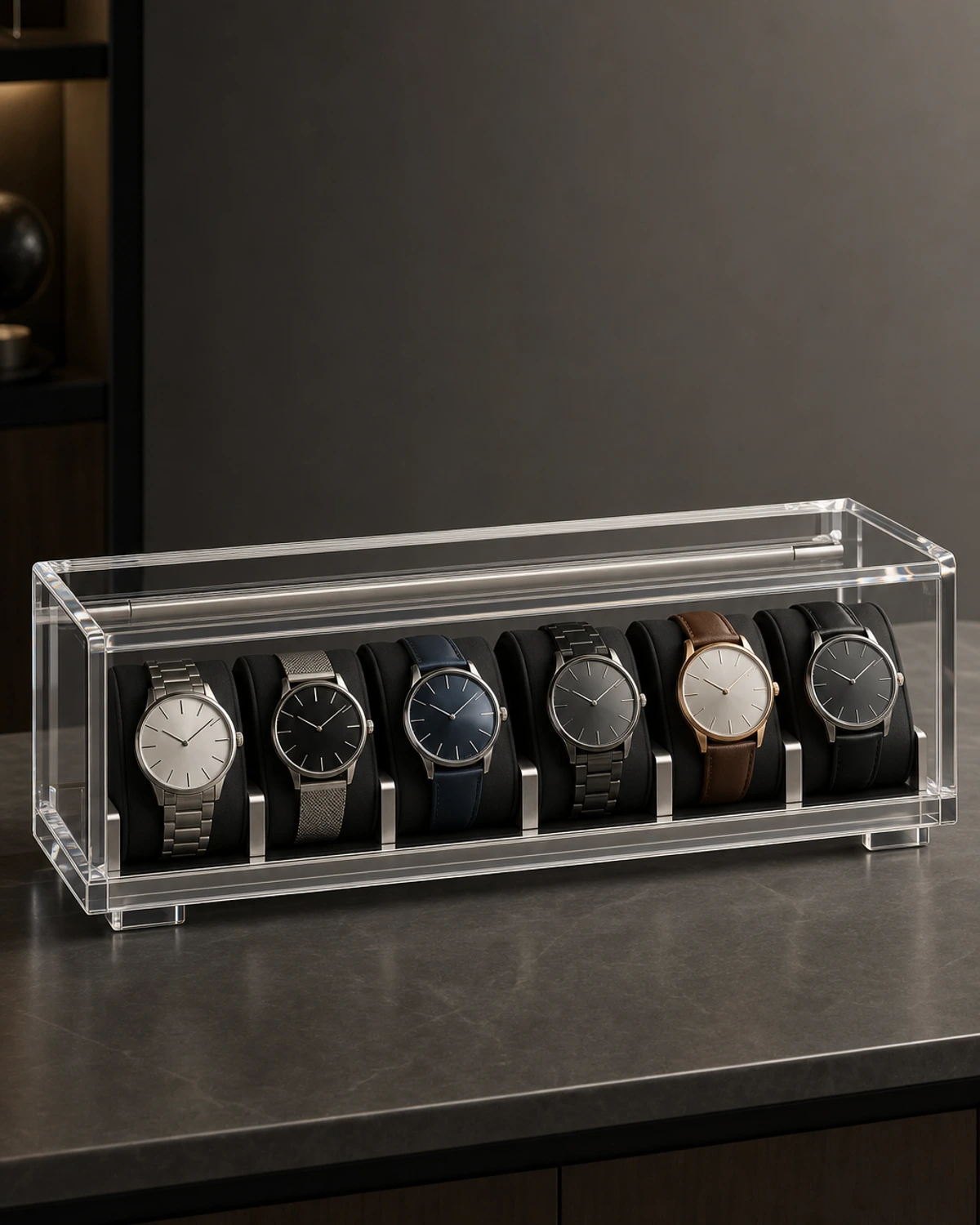
This 60-case, 4-SKU watch-display plan covers 3-, 6-, 12-, and 20-watch formats without turning every order into a new design. Wetop pairs UV-stabilized cast PMMA with a configurable silicone-cradle library, magnetic dust-control hardware, project-defined hinge-cycle testing, and a shared CNC base that keeps the family consistent.
- Program input · program cases
- 60
- Program input · SKU sizes
- 4
- Program input · hinge-cycle target
- 5,000
- Program input · production target
- 15–20 days
Key Takeaways
- Silicone-pillow cradle tolerance for watch-strap diameters from 16 mm minimal to 24 mm chunky tool watch — 5-size cradle insert library covers 95%+ of collector inventory without per-watch custom fitting.
- Magnetic dust-sealed hinge with stainless-steel core + EPDM gasket holds 5+ years of daily winding-cycle openings without seal failure (passed 5,000-cycle opening test before production).
- UV-grade cast PMMA spec is non-negotiable for back-of-cabinet collector display: standard cast yellows visibly at 18-24 months under sustained 8 hr/day room LED, which devastates collector-grade visual presentation.
- 4-SKU lineup (3-watch / 6-watch / 12-watch / 20-watch wall) shares CNC base jig with size-specific inserts, producing per-SKU economics that scale from single-piece commissions to 20-piece collector walls.
The Brief
The buyer ran product for a premium watch collector channel serving boutique watch retailers and serious collectors across US, Switzerland, and Japan. Their existing display options were either generic acrylic cases (no fit-tuning to watch strap diameters, hinges that failed at month 14-18) or full-custom commissions ($800-$2,000 per case, prohibitive at portfolio scale). They wanted a 4-SKU lineup that could serve both single-piece commissions and multi-piece collector walls without each project becoming a from-scratch design.
Constraints: UV-grade substrate (5+ year shelf life under sustained collector-room LED), magnetic dust-sealed hinge that survives 5,000+ opening cycles (= weekly winding), silicone-pillow cradle that holds watch-strap diameters from 16-24 mm without slipping, retail price-point window $200-$650 across the 4 SKUs, lead time inside 4 weeks for non-urgent orders.
Our Recommendation
Three production decisions for collector-channel watch displays.
5-size silicone-pillow cradle insert library
Standard generic watch cases ship with a single cradle dimension that fits some watches loosely and others not at all. Per-watch custom cradles are too expensive at portfolio scale. We built a 5-size cradle library covering 16, 18, 20, 22, and 24 mm strap diameters — sized to fit 95%+ of collector inventory without per-watch custom fitting. Each case ships with the cradle insert(s) appropriate to the buyer's spec'd watch profile.
Magnetic dust-sealed hinge — stainless-core + EPDM gasket
The hinge is a high-risk variable in a daily-use display case. Wetop can specify a stainless-steel core and EPDM gasket, then run the buyer’s agreed opening-cycle test with the actual lid load, opening angle, and environment recorded. A cycle count is a laboratory acceptance target, not an automatic conversion into years of field life.
UV-grade substrate for collector-room display
Standard cast PMMA yellows visibly at 18-24 months under sustained 8 hr/day collector-room LED dwell. UV-stabilized cast holds clarity at 5+ years under identical conditions. The cost premium runs 18-22% per square meter — meaningful but absorbed by the $200-$650 retail price points.
Spec Breakdown and Production
SKU 1 (3-watch tabletop): 240 × 180 × 120 mm, 6 mm UV-grade cast PMMA, magnetic dust-sealed hinge, 3 silicone-pillow cradles (sized to buyer spec). SKU 2 (6-watch tabletop): 360 × 240 × 120 mm, same construction, 6 cradles. SKU 3 (12-watch tabletop): 540 × 240 × 120 mm, same construction, 12 cradles. SKU 4 (20-watch wall): 720 × 360 × 90 mm, wall-mounted with concealed mounting bracket, 20 cradles in 4 × 5 grid.
Production ran 20 days. Substrate sourcing 5 days (UV-grade custom mill batch covering all 4 SKUs in single batch for substrate consistency). CNC + bonded-corner construction 7 days (shared base jig with 4 size-specific inserts). Magnetic-hinge integration 3 days (each hinge cycle-tested on a sample basis before assembly). Diamond polishing 3 days. Final QC + packaging 2 days.
Channel Performance and Repeat Pattern
The four-SKU model lets a collector channel serve tabletop and wall-mounted formats from one controlled family. Reorders can reuse the tooling, cradle library, hinge specification, and material source; a fifth format still receives its own cradle, load, access, and first-off review.
The cradle library produced one operational decision the buyer hadn't anticipated. About 8% of collector inventory fell outside the 16-24 mm strap diameter range — primarily vintage pieces with 14 mm or 26 mm straps. Rather than expand the library to cover the edge cases (which would have added 2 more cradle sizes to the lineup), the buyer chose to handle these as one-off custom cradles produced against the original casing tooling at $35-$50 per cradle. This kept the standard SKU lineup clean while still serving the long-tail of vintage collectors. The decision is one I'd recommend on similar channel programs: the 80% case is library; the 20% edge case is custom-against-existing-tooling, not expanded library.
Long-term hinge performance needs a defined cycle test and field log, not a calendar-life shortcut. Wetop records the hinge source, load, opening angle, gasket compression, cycle count, and inspection condition; the buyer’s field data then shows whether the selected target matches actual use.
The leather-lined cradle option introduced in the 5th SKU produced one supplier-side workflow we hadn't run before. Genuine leather requires solvent-compatibility testing against the case's solvent-bond chemistry — some leather treatments off-gas plasticizers under sealed-case conditions that interact with cast PMMA over multi-year display. We sourced veg-tan leather (no plasticizers) and verified compatibility through a 30-day sealed-case off-gas test before bulk production. The decision added 3 days to the original 4-day SKU engineering window but eliminated the risk of cradle leather degrading the case's optical clarity or off-gas profile over the 5-year design life.
Buyer decision point: A configurable cradle library gives one display family enough fit range for slim dress watches, larger tool watches, and mixed collector inventories.
For watch collector channel product leads or boutique watch retailers scoping a custom display case program, the two decisions worth getting right early are cradle tolerance approach (size-library covering 5 strap diameters vs per-watch custom) and hinge construction (stainless-core with EPDM gasket vs brass consumer-grade). Substrate UV grade is the third decision and is non-negotiable for any collector-room display environment.
Two further specifications collectors typically underweight at brief stage — humidity and lid aperture. Mechanical watches over 35% RH in a sealed case risk movement-oil migration on long dwell; we spec a 4 mm vented baffle channel behind the cradle row to equalize without inviting dust. Lid aperture geometry is the other tolerance: the magnetic dust-sealed hinge opens to 95°, which clears a 44 mm case at full pull but stops short of stressing the gasket compression-set spec under repeat use. Buyers running mixed collector + retail-counter rotations should also reference our extra-large display case buyer guide for the 20-watch wall format mounting load math, and the acrylic cases product hub for the full SKU library.
Spec'ing a watch collector display case program?
Treat the largest watch, thickest strap, opening path, pillow compression, lid clearance, mounting load, and cleaning access as design inputs. A four-SKU family works when those limits are explicit and each case inherits the same approved hardware and finish language.
Send us your watch counts, case and strap dimensions, target SKU range, tabletop or wall format, opening frequency, room lighting, mounting surface, and price window. We’ll return a cradle-library proposal, hinge test plan, material sample, dust-control detail, load review, and unit-cost projection.
Sample timing confirmed after fit review · Production in 15–20 days after approval