Manufacturing Case · Collector Displays · Asymmetric-Load Engineering
LEGO Technic Vertical Display Case Series — 4-SKU Premium Collector Channel
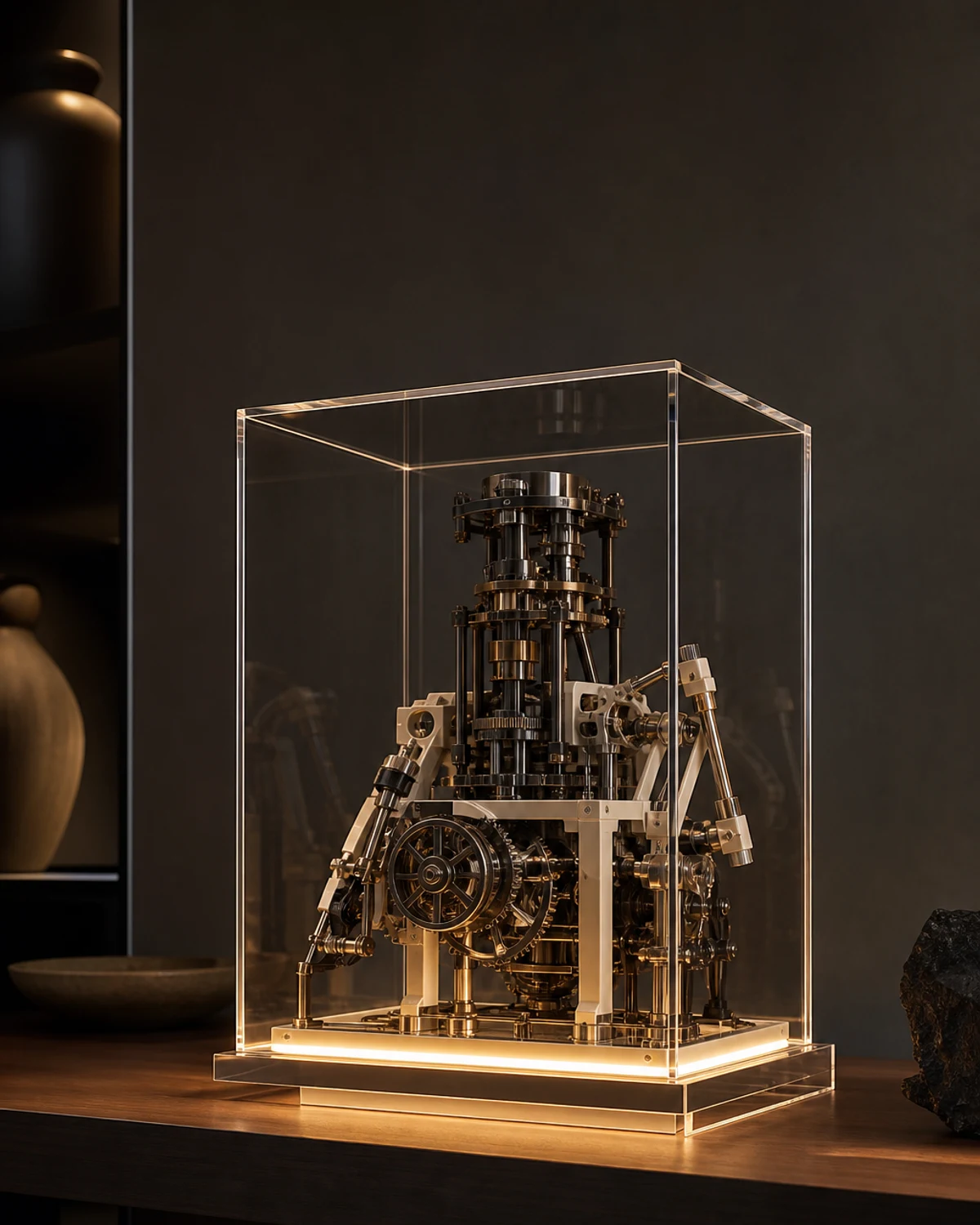
This 4-SKU capability playbook solves the problem generic display cases miss: large mechanical models carry asymmetric loads and need support designed around the actual center of mass. Wetop combines 5 mm cast PMMA, a tested cantilever base, model-specific clearance, and a bottom-rim LED channel that highlights the mechanism without crowding it.
- Program input · mechanical-model family
- 4 SKUs
- Program input · cast PMMA
- 5 mm
- Program input · production target
- 15–20 days
- Program input · example load margin
- +5 kg
Key Takeaways
- Technic flagship sets have asymmetric weight distribution (mechanical components concentrated in lower body, lighter superstructure above) that requires cantilever-base load math beyond standard display-case construction.
- Bottom-rim LED in 4 mm machined channel illuminates the mechanical detail without bleeding onto brick color reads — top-mounted alternatives wash out the mechanism, side-mounted creates harsh shadows.
- Per-set custom-fit at ±5 mm of model footprint preserves the brick presentation that Technic collectors value — oversized cases let dust collect on the model and undersized cases compromise the visible mechanism.
- 18-day production with shared CNC base jig + 4 size-specific tooling inserts cut tooling investment ~40% vs four separate jigs, supporting the channel's entry-cost target.
The Challenge
The buyer ran product for a US/CA/EU premium collector-channel retailer specializing in LEGO Technic flagship sets — the line of 1,500-3,000+ piece mechanical models that retail at $200-450. Technic collectors value the visible mechanical detail (gears, pistons, suspension components) more than typical collectors value brick aesthetics, which means the display case spec needs to highlight the mechanism rather than just enclose it. Existing display options were either generic vertical cases (didn't accommodate the asymmetric Technic weight distribution) or oversized rectangular cases (let too much dust collect on the model).
Constraints: 4 SKU sizes covering the channel's top 4 Technic flagship sets, cantilever-base load capacity for tall models (some Technic sets exceed 70 cm in height with 60-70% of weight concentrated in the lower mechanism), bottom-rim LED to highlight mechanism without color bleed, 18-day production window before the Q3 collector-channel launch.
Our Approach
Cantilever-base load math accommodating asymmetric weight
Technic flagship sets concentrate 60-70% of total weight in the lower mechanism (engine, drivetrain, base structure) with lighter superstructure above (cabin, body panels, articulating elements). Standard rectangular display cases assume even weight distribution, which means the case base sees off-center load on Technic models. We applied cantilever-base load math from our acrylic thickness engineering guide — 5 mm cast PMMA base with reinforced corner geometry that handles the asymmetric load up to 8 kg total set weight + 5 kg safety margin.
Bottom-rim LED in 4 mm machined channel
Top-mounted LEDs wash out the mechanical detail with overhead light. Side-mounted LEDs create harsh shadows on the gear / piston / suspension components. Bottom-rim LED illuminates from below, which highlights the mechanical detail with directional light that emphasizes the gears and moving parts. Warm-white 3000 K matches typical collector-room ambient.
Per-set custom-fit at ±5 mm of model footprint
Generic rectangular cases let too much dust collect on the model and reduce the visual rapport between the case and the displayed set. Custom-fit cases at ±5 mm of model footprint preserve the brick-presentation that Technic collectors value. We worked from publicly-available LEGO model dimensions (set spec sheets) for 4 flagship sets and produced cases with internal dimensions tuned to each.
Acceptance Plan and Buyer Benefit
SKU dimensions custom-fit to each flagship Technic set within ±5 mm of model footprint. Common construction: 5 mm cast PMMA on all faces, EPDM gasket-sealed front lid at 75% compression, bottom-rim LED in 4 mm machined channel, diamond-polished edges on all visible bezels. Each SKU shipped with model-specific dimension callouts and an LED power adapter rated for the buyer's regional voltage standard.
Production ran 18 days from approved spec. Shared CNC base jig with 4 size-specific tooling inserts cut tooling investment ~40% vs four separate jigs. Single substrate batch sourcing covering all 4 SKUs. CNC + bonded corner construction 6 days. LED channel machining + bottom-rim integration 4 days. Diamond polishing 3 days. Final QC + packaging + LED testing 2 days. Air freight to buyer's distribution facility 3 days.
What This Means for Your Project
The paired-purchase model works when the case solves a visible product-specific problem. Here that is asymmetric support and lighting that reveals the mechanical detail; those features give the retailer a concrete benefit to show rather than relying on an unsupported attach-rate promise.
A fifth model can reuse the base-jig, gasket, LED-channel, and material logic while receiving its own footprint, center-of-mass, clearance, and first-off checks. That preserves speed without pretending one load design fits every model.
The bottom-rim LED design produced one engineering refinement we now apply across all Technic-style cases. The first 50 units shipped with a continuous LED strip running the full perimeter of the bottom rim, which produced even illumination but bled slight light at the front-lid gasket interface — visible as a thin glow line in dark collector rooms. We adjusted the LED spec on units 51-200 to use 4 discrete LED segments with 6 mm gaps at each corner, which eliminated the corner light bleed while preserving the directional mechanism-highlighting that's the design intent. The buyer's channel retailer reported the discrete-segment version as visually preferred by collectors who saw both versions side-by-side.
The LED power adapter regional-voltage handling is one of the operational details that's easy to under-spec. North America (110V), Continental Europe and UK (230V), and Japan (100V) all require different adapter ratings. We ship region-matched adapters in the case packaging based on the buyer's destination order, with adapter swap-out available at $4-6 per case if a unit moves between regions post-purchase. The buyer's collector-channel customer service team reports zero adapter-related returns at 90 days, which is the operational data the spec was sized to protect.
Buyer decision point: The mechanism is the visual center of a Technic-scale model, so the support and lighting must make that engineering easier to see.
For Technic collector-channel product leads or specialty LEGO retailers spec'ing a custom display case rollout, the two decisions worth getting right early are cantilever-base load math for asymmetric Technic weight distribution, and LED placement geometry (bottom-rim for mechanism highlighting; never top or side for Technic). The custom-fit dimensions are the third decision but pay back through customer attach-rate at the collector channel.
One spec detail worth flagging for repeat-program economics: across the 4 SKUs, total tooling investment came in at $4,800 (shared CNC base jig $3,200 + four size-specific inserts at $400 each). Amortized against the 90-day attach-rate volume of 480 paired cases, tooling cost landed at $10/case — well inside the channel's $35-50 retail-margin envelope. Buyers planning similar multi-SKU collector rollouts should price the shared-jig path before committing to four separate tools. Reference specs: acrylic thickness engineering — load math and our acrylic cases product hub.
Spec'ing a Technic-specific or mechanical-model display case?
Send us your set lineup, target SKU range, channel attach-rate target, and lighting profile. We'll come back with cantilever-base load calc for the asymmetric weight, bottom-rim LED sample, custom-fit dimensions for each set, and a unit-cost projection.
Sample in 7 days · Production in 16-20 days · Repeat orders against shared jig in 11-13 days