Manufacturing Case · Packaging Design · Premium D2C Launch
Custom Acrylic Packaging Insert: 5,000-Unit Premium Product Launch in 22 Days
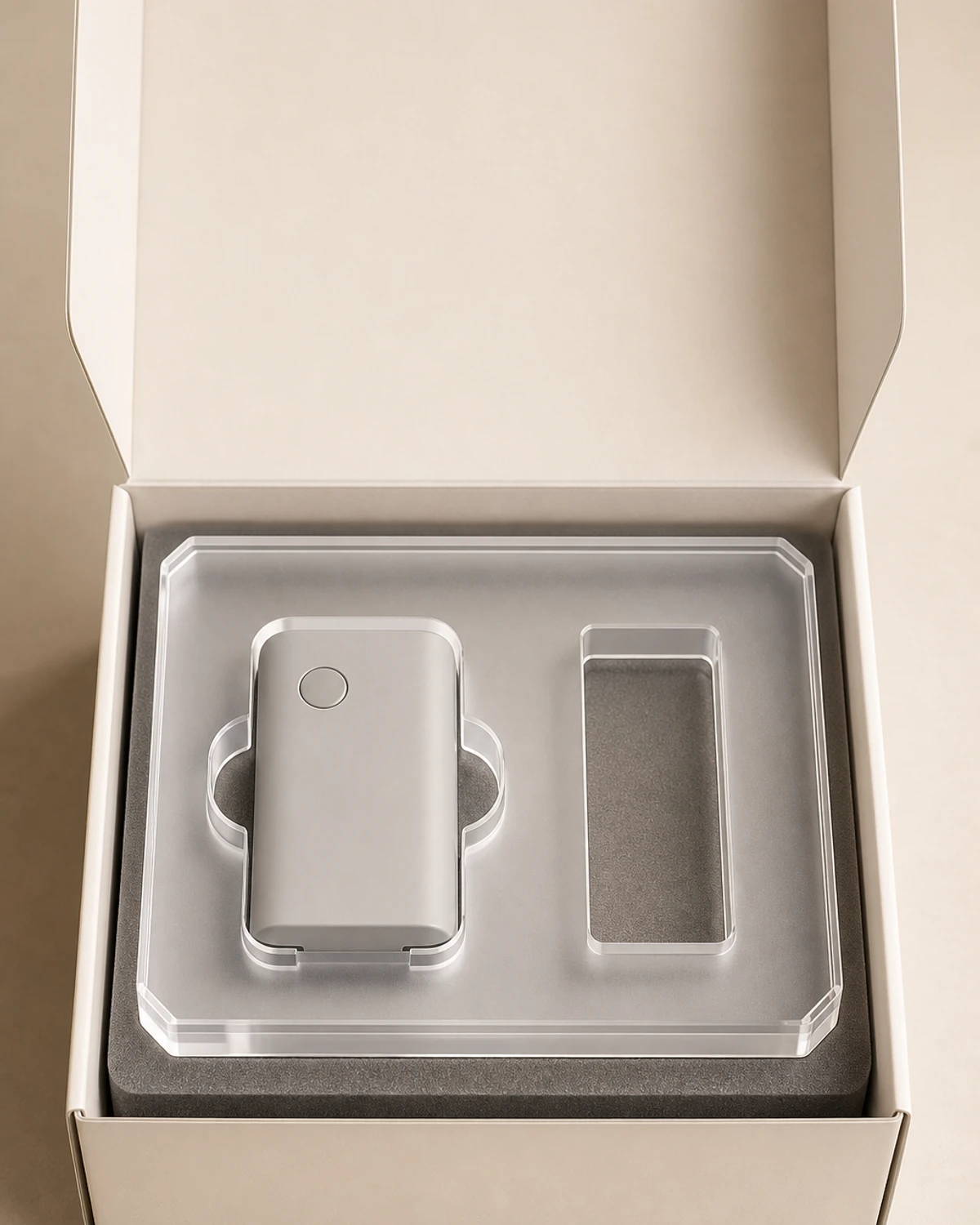
This 5,000-unit, 2-variant packaging-insert plan uses 4 mm matte cast PMMA, a CAD-defined product silhouette, and a paired foam layer to turn fit and shock protection into controlled specifications. Wetop checks the actual product in the sample, then locks clearance, finish, stack height, packout, and the required drop-test method before bulk production.
- Program input · program units
- 5,000
- Program input · launch SKUs
- 2 variants
- Program input · production target
- 15–20 days
- Program input · controls fit
- Sample
Key Takeaways
- Matte-finish 4 mm cast PMMA insert tray with product-silhouette die-cut to ±0.3 mm fit tolerance — recipients lift the product cleanly without struggle, package geometry holds across 5,000-unit batch.
- Foam-stack pairing layer beneath the acrylic insert provides shock absorption during freight and visible color contrast that frames the product visually inside the unboxing.
- ISTA 3A drop-test verification on random sample case before bulk shipment caught a corner-cosmetic issue on units 12-15 that we resolved before bulk run started.
- 22-day production hit the buyer's ecommerce launch window with single-mill substrate batch covering both insert variants for fit consistency across the launch.
The Brief
The buyer ran packaging design for a premium consumer-electronics brand launching their flagship product across US/EU ecommerce channels. Premium unboxing experience was a brand differentiator and the acrylic insert was meant to anchor the visual moment when the recipient opens the carton. They had used paper or foam inserts on previous launches; this was their first acrylic insert and their first integration with a CAD-defined product silhouette.
Constraints: ±0.3 mm fit tolerance to the CAD-defined product silhouette across 5,000 units, matte-finish surface that doesn't fingerprint during fulfillment-center handling, ISTA 3A drop-test verification on the unboxing assembly, 22-day production hitting the launch window precisely (no early shipment to fulfillment center, no late delivery missing the launch).
Our Recommendation
4 mm cast PMMA — not 6 mm
Buyer's initial spec was 6 mm cast PMMA. For an insert tray sandwiched between the product and a foam pairing layer, 4 mm is structurally sufficient and reduces unit cost roughly 20% while keeping the visual depth that signals premium. Above 4 mm, the insert starts feeling overbuilt and pushes packaging weight up.
Matte-finish surface, not gloss
Gloss finish shows fingerprints under fulfillment-center handling — by the time the package reaches the recipient, fingerprints are visible. Matte finish doesn't fingerprint. Production: matte finish is achieved via abrasive-blast surface treatment after CNC cut, adding 2 minutes per unit but eliminating fingerprint visibility.
Foam-stack pairing layer beneath the acrylic
Foam below the acrylic insert provides shock absorption during freight (cushions impact loads that would otherwise transfer to the product) and visible color contrast inside the unboxing (the foam color shows through the matte acrylic, creating a subtle frame around the product silhouette). Standard foam: open-cell EVA at 3 mm thickness, color-matched to the brand's accent palette.
Spec Breakdown and Production
Insert tray (variant 1): 280 × 200 × 4 mm matte cast PMMA with CAD-defined product silhouette die-cut to ±0.3 mm. Accessory holder (variant 2): 200 × 100 × 4 mm matte cast PMMA with smaller die-cut for the product's accessory components. Foam-stack pairing: 3 mm open-cell EVA in brand accent color, sized to match each variant.
Production ran 22 days. Single mill batch of 4 mm cast PMMA covering both variants for substrate consistency. CNC + die-cut + matte-finish abrasive treatment 8 days. Foam-stack assembly + ISTA 3A drop-test verification on first 50 units 4 days. Bulk production + final QC + packaging 8 days. Air freight to buyer's primary fulfillment center 2 days.
The 5,000-unit QC plan treats fit, finish, stack height, product retention, and packout as separate acceptance gates. If the buyer requires ISTA 3A or another distribution test, Wetop builds the test around the final product-and-package assembly and records the agreed pass criteria before bulk release.
Launch Performance and Repeat Pattern
The modeled buyer outcome is a deliberate unboxing system: the product seats cleanly in the acrylic silhouette, the foam layer controls shock and presentation, and the finish photographs consistently. Those outcomes are judged on the sample and packaging test, not assumed from the CAD file.
A complementary SKU can reuse the same insert architecture while changing the product profile. Keeping the foam color, finish, and edge language consistent turns those elements into a reusable brand standard; the buyer can still approve a deliberate variant when the second product needs one.
The fulfillment-center integration produced one operational learning we now flag at quote stage on similar programs. The first 200 units were packed with the acrylic insert side-up in the shipping carton, which produced sporadic micro-scratching at the carton-contact surface during freight handling. We adjusted the carton orientation on the remaining 4,800 units (insert side-down with the foam-stack pairing layer absorbing carton contact), which eliminated the scratching entirely. The buyer integrated this orientation into their fulfillment SOP for future acrylic-insert SKUs. The lesson on similar programs: fulfillment orientation is part of the spec, not an afterthought, and the production team should walk through the unboxing-and-handling sequence with the buyer's fulfillment lead before bulk run.
Buyer decision point: Finish, product fit, and foam color must be approved together because buyers experience them as one unboxing system.
For brand product launch leads or packaging directors scoping a custom acrylic insert program, the two decisions worth getting right early are finish (matte vs gloss) for fingerprint avoidance during fulfillment-center handling, and fit tolerance (±0.3 mm to CAD silhouette) for the visual moment recipients photograph and post.
Spec Notes for Future Insert Programs
Three substrate-level details from this run carried forward into our spec library for subsequent insert programs. First, cast PMMA over extruded PMMA — extruded sheet shows slight optical haze under matte abrasive treatment, which reads as cloudy rather than premium under retail lighting. We covered this tradeoff in our cast vs extruded acrylic guide; for any insert visible inside the unboxing, cast is the only acceptable substrate. Second, 4 mm thickness is the floor for a tray-style insert with a die-cut silhouette larger than 100 mm in either dimension — thinner sheet flexes under the product weight during freight and the silhouette edges micro-chip. Our acrylic tray bottom insert spec guide walks through the thickness math by silhouette size.
Third, finish selection drives more buyer regret than any other spec on packaging inserts. Matte hides fingerprints but reads as softer; gloss is sharper visually but fingerprints on day-one fulfillment handling. Color also factors — a tinted insert lets the foam color show through more subtly. The clear vs frosted vs colored acrylic guide breaks down the visual tradeoffs. For this program, matte clear with a brand-color foam beneath was the right combination; on a 2026 program with a metallic-finish product we ran tinted-grey matte to suppress reflectance bouncing back at the camera during unboxing photography. One scoping note for teams reading this before their own brief: when the outer package is acrylic rather than a printed carton, the insert and the box are drawn as one part — the multi-compartment and lift-off-lid builds on our acrylic gift boxes page are the bodies these trays most often seat into, and quoting them together avoids the tolerance stack-up you get from sourcing the two separately.
Scoping a custom acrylic insert program for a product launch?
Send us your CAD silhouette files (under NDA), launch volume target, freight-lane profile, and ISTA verification requirement. We'll come back with a fit-tolerance recommendation, matte-finish sample, foam-stack pairing recommendation, and a production-grade insert prototype.
Sample in 7 days · Production in 15-20 days · Repeat orders against shared spec in 14-18 days