Manufacturing Case · Specialty Retail (Mahjong) · Premium Hospitality
Boutique Mahjong Club: 60-Locker Acrylic Display Wall in 24 Days
This 60-locker acrylic wall plan turns a member-storage requirement into a branded hospitality feature. Wetop builds numbered modules in 6 mm UV-stabilized cast PMMA, matches the approved engraving or UV-print process, specifies stainless-core lock hardware, and supplies an anchor layout and key schedule so the installation team receives a controlled system rather than 60 loose boxes.
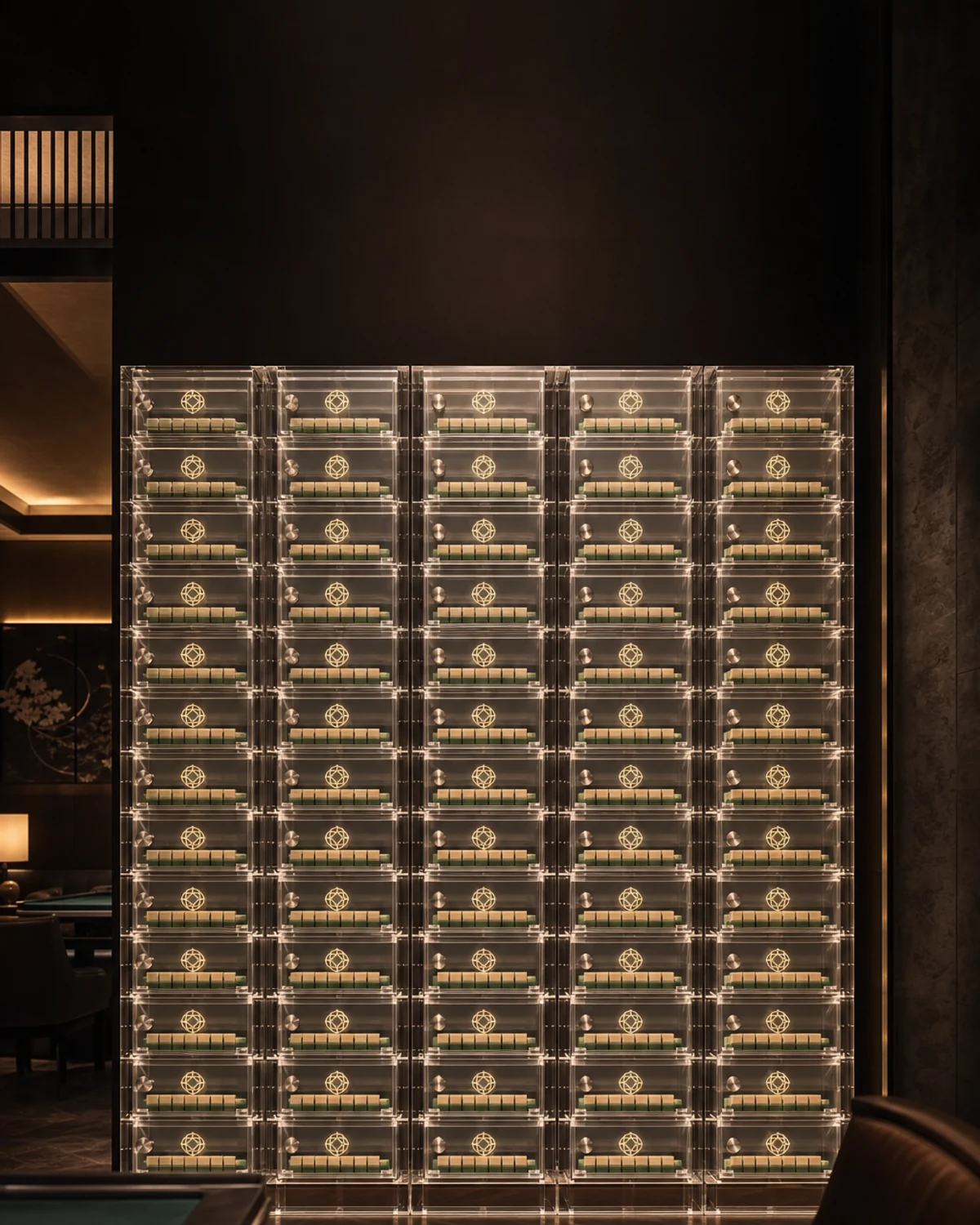
- Program input · member lockers
- 60
- Program input · cast PMMA
- 6 mm
- Program input · production target
- 15–20 days
- Program input · hinge-cycle target
- 5,000
Key Takeaways
- Anti-yellow cast PMMA grade (UV-stabilized polymer additive) is the spec that decides whether a locker wall reads premium for 5 years or visibly degrades by month 18 under continuous lounge LED dwell.
- Member-controlled keying (each locker keyed to one member, not master-keyed) was the operational decision that made the wall a premium-tier amenity instead of a back-of-house storage solution.
- Brand-color UV etch on the locker face — 0.5 mm channel depth in the brand sage-gold — was the visual signature that made the wall a club asset rather than 60 generic cases stacked vertically.
- Lockable-case hinges are spec'd SUS304 stainless core with EPDM gasket — rated 5,000+ opening cycles (about 5 years of weekly use); consumer-grade brass hinges loosen far sooner in a humidity-variable lounge.
- Anchored install with concealed steel back-bracing was specified after the floor-loading review; 60 lockers with 144-tile sets each totals 130+ kg distributed across the wall, requiring structural anchor points at six places.
The Brief
The buyer was the founder of a premium boutique mahjong lounge with a single flagship location in East Asia and an early-stage second location under fit-out. The flagship had been operating two years on a fee-based membership model — annual membership tier with weekly play access — and the founder had been planning a member-locker amenity from the original space design but hadn't found a manufacturer who could deliver the three specs that mattered.
The constraints she came to us with:
- Long-term appearance under lounge lighting. The material grade, engraving or print process, cleaning method, and actual LED exposure are reviewed together. The buyer approves the sample under the room’s lighting and sets the required appearance target.
- Member-controlled keying. Initial fit-out plan had master-keying (one set of keys for staff). The founder pivoted mid-rollout to member-controlled — each member receives the only operational key to their locker. Operational shift, not mechanical, but it changed the keying spec and the key-issuance workflow.
- Brand-asset visual identity. 60 generic acrylic cases stacked vertically would have read as back-of-house storage. The wall needed a brand-asset visual signature — sage-gold UV etch in the lounge's brand color on each locker face — that converted the storage function into membership-tier visible status.
The previous quote on her desk had specified standard cast PMMA (not UV-stabilized), brass hinges (consumer-grade), and surface UV print (not etched depth). She came to us asking whether the 5-year-lifespan spec could be met without changing the lounge's per-member capex math.
Our Recommendation
Three changes from the original spec, each driven by long-term use rather than install-day appearance.
UV-stabilized cast PMMA, not standard cast
Standard cast PMMA holds optical clarity for 5+ years under standard retail or office lighting. Under continuous lounge LED dwell at 12 hours/day, however, the engraved channel develops yellowing within 18-24 months because the localized heat at the etch surface accelerates polymer degradation. UV-stabilized cast PMMA includes a UV-absorber additive in the polymer mix that pushes the yellowing onset to 60+ months under identical dwell. The cost premium on UV-stabilized substrate is roughly 18-22% per square meter; on a 60-locker wall at typical locker dimensions, that's about $4-$6 of substrate premium per locker. Trivial against a 5-year-vs-2-year amenity lifespan.
Stainless-core hinges with EPDM gasket, not brass consumer-grade
Brass hinges look premium at install and loosen far sooner under weekly opening cycles in a humidity- variable lounge environment. Stainless-core (SUS304) hinges with EPDM gasket are rated for 5,000+ opening cycles (about 5 years at weekly opening) without dimensional drift or gasket failure. The cost premium is real ($14-$18 per hinge vs $4-$6 for brass) but pays itself off after the first hinge replacement event. We spec hinges to that rating and confirm the fit and action on a pre-production sample before committing to production.
UV etch at 0.5 mm channel depth, not surface UV print
Surface UV print on a locker face holds 18-30 months under daily-touch use; the print scratches and delaminates at the edge of the print zone. UV etch at 0.5 mm channel depth (laser-engraved channel filled with UV-cure pigment) holds 5+ years because the pigment is recessed below the surface and protected from mechanical wear. The depth also reads as deliberate brand-craft when the member touches it, which is the tactile signal we wanted on the wall.
Spec Breakdown and Production
Each locker measured 280 × 200 × 60 mm — sized to hold one 144-tile mahjong set in our standard insert tray with margin for member-personal items (a small token, an envelope, a tally book). 6 mm UV-stabilized cast PMMA on all six faces (front + 4 sides + back), with the front face hinged and lockable. Stainless-core hinges, EPDM gasket, member-keyed cylinder lock at the front-right corner. Brand-color sage-gold UV etch across the front face — channel depth 0.5 mm, channel width 6-8 mm at character strokes, character height 22 mm.
Production ran 24 days from approved spec to install-ready. Substrate sourcing took 14 days because the UV-stabilized grade is not stocked at Wetop's standard mill relationship — we ordered a custom mill batch sized to the entire 60-locker run plus 5% spare-substrate allocation. Once substrate arrived, CNC and laser-etch ran 6 days, polishing and bonding ran 3 days, and final assembly + QC ran 1 day. The hinge 5,000-cycle test was completed during the substrate-sourcing window so it didn't add to the critical path.
Install ran 3 days on-site. The lounge had specified a structural wall anchor pattern from the original fit-out, and the locker mounting brackets keyed into that pattern. Day 1: structural anchor verification + back-bracing install. Day 2: locker placement + alignment (60 lockers across 5 vertical columns × 12 rows). Day 3: key issuance + member-cylinder verification + soft-launch member walk-through.
Lessons and Five-Year Operational View
The wall has been operating 14 months at the time of writing. Yearly inspection (which we run on an extended-warranty basis as part of the install commitment) confirms zero yellowing at the engraved channel, zero hinge failure across all 60 lockers, and zero key-cylinder issues from members. The lounge has added 22 new members against the original 60 since the wall installed — the founder's read is that the visible status object measurably accelerated member acquisition for the boutique tier.
Three operational notes worth flagging for any boutique club operator scoping a similar amenity. First, member-controlled keying creates a key-tracking responsibility (the lounge maintains a backup key safe with duplicates, locked to the founder's biometric). Second, the wall reads as a brand asset only when its immediate environment is also brand-coherent — the lounge invested in the wall + member room lighting + floor finish as a single program, not separately. Third, spare substrate allocation matters: at 18 months, one locker had a face-cosmetic incident (member dropped a set during retrieval, edge-chip on lower corner). We had a replacement locker face fabricated from the spare substrate within 5 days, matching the original batch's color and finish exactly.
Buyer decision point: A member-locker wall is both storage and a visible hospitality asset, so branding, hardware, numbering, lighting, and installation must be designed as one system.
For boutique club operators or hospitality fit-out leads scoping a similar member-locker amenity, the two decisions worth getting right early are substrate grade (UV-stabilized cast PMMA if the wall is in continuous lighting environment; standard cast only if dwell is below 6 hours/day) andhinge spec (stainless-core with EPDM gasket, not brass). The brand-color UV etch is what makes the wall a brand asset rather than 60 storage cases — but only after the substrate and hinge decisions are locked.
Scoping a member-locker or boutique-tier acrylic amenity?
Send us your member count, environment lighting hours, and brand-color spec — we'll come back with substrate grade recommendation, hinge cycle-test results, brand-color UV etch sample, and a 5-year operational projection.
Sample in 7 days · Production in 22-28 days · UV-stabilized substrate sourcing 14 days lead